

ASTM B574 Hastelloy C2000 Alloy Bar
Product Introduction
Permalloy 80 is highly regarded for its extremely high magnetic permeability, low coercivity, and near-zero magnetostriction. It is an ideal choice for applications such as transformer and relay cores, magnetic shielding for blocking external magnetic fields, and recording heads.
Chemical Composition
| Material Type | C | Co | Ni | Cr | Mo | Cu | Fe |
|---|---|---|---|---|---|---|---|
| Hastelloy C2000 | ≤0.01 | ≤2.0 | 59 | 22.0-24.0 | 15.0-17.0 | 1.3-1.9 | ≤3.0 |
Mechanical Properties
| Tensile strength | Yield strength | Elongation | Hardness |
|---|---|---|---|
| ≥ 690 MPa | ≥ 283 MP | ≥ 40% | Not mandatory, reference ≤ 100 HRB |
Generally, the mechanical properties of our bars are sampled axially, which differs slightly from the transverse properties of plates.
If used at high temperatures (e.g., above 300℃), we need to provide customers with high-temperature tensile data for Alloy C2000 to assess strength decay.
Supply Specifications and Industry Standards
1. Inventory Sizes and Customization:
The common diameter of Hastelloy C2000 alloy bars ranges from Φ6mm to Φ300mm. They are usually supplied as blanks. During peak purchasing seasons and when raw materials are scarce, custom orders are required, with a long lead time, typically 3-6 months.
Additionally, we supply three types of bars: cold-drawn bright round bars, hot-rolled black-skinned round bars, and forged machined round bars. The differences are as follows:
Cold-drawn bright round Alloy C2000 bars: Φ6-20mm, smooth surface, high precision, suitable for direct use in small shafts and fasteners.
Hot-rolled black-skinned round Alloy C2000 bars: Φ20-90mm, surface has oxide scale, requires machining.
Forged machined round Alloy C2000 bars: Φ90-300mm, large diameter bars, smooth surface, used for large valve stems and pump shafts.
The bars we supply are generally 3-6 meters in length, but custom lengths are also available. When requesting a quote, we need to confirm whether delivery is by length or custom length.
2. Supply Standards (Core):
The commonly used standard for Hastelloy C2000 alloy bars is ASTM B574 (the standard specification for nickel-chromium-molybdenum alloy bars, defining chemical composition, mechanical properties, dimensional tolerances, and heat treatment requirements). Other standards such as ASME SB-574 and AMS 5759 are also applicable to different fields.
Quality Inspection Process
We generally offer a free quality inspection process to ensure that the delivered materials meet standard requirements. This typically includes two processes: initial inspection and re-inspection. The initial inspection process consists of five steps: goods list verification, surface observation, packaging safety and compatibility inspection, dimensional tolerance measurement, and quantity verification. The re-inspection consists of four steps: secondary dimensional tolerance measurement, quantity verification, handheld spectrometer chemical composition testing, and hardness testing. Additional paid testing may include non-destructive testing, corrosion performance testing, and mechanical property testing. Non-destructive testing includes ultrasonic testing (UT) and surface testing (PT). We generally conduct targeted testing based on customer needs and material characteristics, and the price varies. Please contact our material experts to explain your specific needs and obtain a real-time quote.
Of course, medical-grade and aerospace-grade materials, which we frequently encounter, have more stringent requirements than those in other industries, resulting in unique performance demands. We generally recommend that these materials undergo testing by a third-party authoritative organization (such as SGS) during the sample testing phase when necessary. These organizations will issue test reports based on material standards, allowing you to gain a more comprehensive understanding of the material's final use during the sample procurement stage. This helps prevent losses from bulk purchases due to errors in material supply or substandard performance.
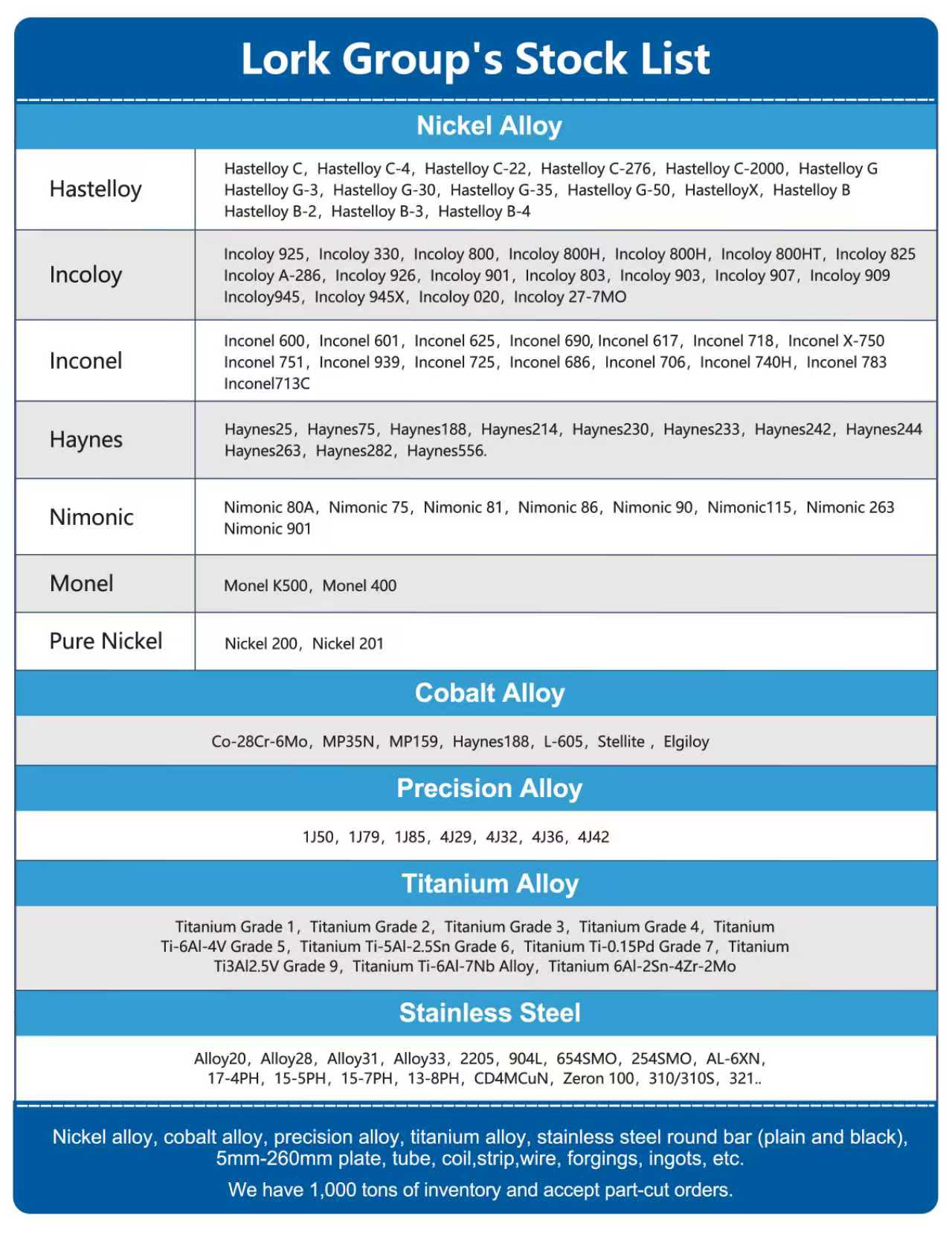
Other products in stock
We are a professional supplier of metal raw materials
Long-term supply of the following materials:
- Nickel Alloy
- Cobalt Alloy
- Titanium Alloy
- Precision Alloy
- Stainless Steel