
Guide to Selecting Inconel Sheet, Strip, and Plate: A Comprehensive Analysis of Mainstream Grades, Standards, and Applications for 2026
2026-09-23
Introduction
Inconel nickel-based alloy sheets, strips, and plates are core materials for manufacturing high-temperature, corrosion-resistant equipment. The most common challenge in procurement is not availability, but rather determining which standard to use for acceptance when a single alloy grade has multiple standard versions. Do AMS 5889 strips and ASTM B168 plates share the same mechanical property requirements? Both Inconel 617 and 625 withstand high temperatures—which one is the better choice?
This article categorizes 12 Inconel grades (covering sheets, strips, and plates) based on grade, standard, and application. It breaks down chemical composition, mechanical properties, applicable standards, and use cases to help engineers and procurement professionals quickly identify the right materials for their needs.
Comparison of 12 Major Inconel Alloy Grades and Standards (Sheet, Strip, and Plate Forms)
Before discussing suppliers, it is essential to clarify the alloy grades. A common pitfall in procurement is confusing Stellite 6 with Stellite 12; while they look similar, their performance characteristics and suitable applications differ vastly.
| Alloy Grade | UNS | Primary Standard (Plate/Strip) | Tensile Strength (MPa) | Yield Strength (MPa) | Elongation (%) | Core Positioning |
|---|---|---|---|---|---|---|
| Inconel 600 | N06600 | ASTM B168 / AMS 5540 | ≥550 | ≥240 | ≥30 | A standard grade offering corrosion and heat resistance, as well as resistance to chloride-induced stress corrosion cracking (SCC); a classic material for the nuclear industry. |
| Inconel 601 | N06601 | ASTM B168 / AMS 5870 | ≥650 | ≥300 | ≥30 | A benchmark for high-temperature oxidation resistance; contains 1.0–1.7% aluminum and withstands temperatures up to 1,200°C. |
| Inconel 617 | N06617 | ASTM B168 / AMS 5888(sheet)/5889(strip) | ≥810 | ≥410 | ≥54 | Solid-solution strengthened superalloy featuring outstanding creep strength above 980°C; specifically designed for gas turbine combustion chambers. |
| Inconel 625 | N06625 | ASTM B443 / AMS 5599 / AMS 5869 | ≥830 | ≥415 | ≥30 | Corrosion-resistant and high-strength; resistant to seawater pitting; the preferred choice for marine, chemical, and flue-gas desulfurization applications. |
| Inconel 690 | N06690 | ASTM B168 / ASME SB168 | ≥550 | — | — | High-chromium (~30%), specifically for steam generator heat transfer tubes in nuclear power plants, resistant to stress corrosion. |
| Inconel 693 | N06693 | ASTM B168 | — | — | — | High chromium + aluminum; suitable for extreme oxidation/carburization environments; offers superior corrosion resistance compared to 601. |
| Inconel 718 | N07718 | ASTM B670 / AMS 5596 | ≥1276 | ≥1034 | ≥12 | Precipitation-hardening type; high strength at temperatures up to 700°C; a mainstay material for aero-engines and gas turbines. |
| Inconel 706 | N07706 | AMS 5701 | — | — | — | A variant of 718 with improved machinability, used for large forgings and rings. |
| Inconel X-750 | N07750 | ASTM B637 / AMS 5598(sheet/strip) | ≥1173 after aging | ≥747 after aging | ≥30 after aging | Age-hardenable; high strength up to 871°C; suitable for springs, fasteners, and seal rings. |
| Inconel 725 | N07725 | ASTM B805 / NACE MR0175 | ≥855(after aging) | ≥427(after aging) | ≥57 | Age-hardened version of 625; strength doubled; designed specifically for acidic oil and gas wells. |
| Inconel 625 LCF | N06626 | ASTM B443 | ≥830 | — | — | Low-carbon version of 625, specifically designed for low-temperature fatigue resistance. |
| Inconel 740H | N07740 | ASME Code Case 2702 | — | — | — | Advanced ultra-supercritical boiler tubes/plates, designed for 620–760°C steam environments. |


Data Notes:
The mechanical data in the table represent typical minimum values or typical values.
- For Inconel 600, typical room-temperature properties are: tensile strength 655 MPa, yield strength 310 MPa, and elongation 45%.
- For annealed Inconel 601, minimum values are: tensile strength 650 MPa, yield strength 300 MPa, and elongation 30%.
- For Inconel 625 cold-rolled sheet/strip (ASTM B443 Grade 1), minimum values are: tensile strength 827 MPa, yield strength 414 MPa, and elongation 30%.
- For Inconel 617 solution-annealed sheet, typical values are: tensile strength 810 MPa, yield strength 410 MPa, and elongation 54%.
- For Inconel 718 (per AMS 5662), room-temperature requirements are: yield strength ≥1034 MPa, tensile strength ≥1276 MPa, and elongation ≥12%.
Detailed Explanation of Standard Coverage
1. ASTM B168 (the latest version being B168-26) is the "master standard" for Inconel flat products, covering plate, sheet, and strip in the following UNS designations:
- Nickel-chromium-aluminum alloys: N06699
- Nickel-chromium-iron alloys: N06600, N06601, N06603, N06690, N06693, N06025, N06045, N06696
- Nickel-chromium-cobalt-molybdenum alloys: N06617
- Nickel-iron-chromium-tungsten alloys: N06674
- Nickel-chromium-molybdenum-copper alloys: N06235
Note: Inconel 625 (N06625) and 718 (N07718) are not covered by ASTM B168. Plate and strip products for alloy 625 are covered by ASTM B443, while those for alloy 718 are covered by ASTM B670. Plate and strip products for Inconel X-750 are covered by ASTM B637.
The AMS series of standards primarily targets aerospace applications, imposing additional requirements regarding grain size and non-destructive testing:
| AMS Standard | Covered Grades | Product Form | Key Additional Requirements |
| AMS 5540 | Inconel 600 | Sheet/Strip | Grain Size Control |
| AMS 5870 | Inconel 601 | Sheet/Strip | Supplied in solution-annealed condition |
| AMS 5888 | Inconel 617 | Plate | Ultrasonic testing |
| AMS 5889 | Inconel 617 | Strip | Grain size, surface quality |
| AMS 5599 | Inconel 625 | Sheet/Strip | Aviation-grade traceability |
| AMS 5869 | Inconel 625 | Sheet/Strip | High purity requirements |
| AMS 5596 | Inconel 718 | Sheet/Strip | Mechanical Acceptance Testing in the Aged State |
| AMS 5598 | Inconel X-750 | Sheet/Strip | Age-hardened state |
Procurement Reminders and Common Pitfalls
Pitfall 1: Disputes arising from mixing AMS and ASTM standards
For the same alloy grade, AMS and ASTM standards may specify similar chemical compositions but differ in mechanical property requirements. For instance, the ASTM B166 standard for Inconel 601 bars requires a yield strength of ≥240 MPa, whereas the ASTM B168 standard for plates requires only ≥205 MPa. If you use the B166 criteria to inspect B168 plates, material that actually meets specifications could be wrongly rejected.
Pitfall 2: Applying plate specifications to strip material
ASTM B443 Grade 1 requires a yield strength of ≥414 MPa for Inconel 625 strip, while the requirement for hot-rolled medium-to-heavy plate (≤70 mm) may be as low as 379 MPa. Strip is strengthened through cold rolling and naturally possesses higher strength than hot-rolled plate. Problems arise if strip specifications are used to inspect plate, or vice versa.
Pitfall 3: Vague grain size requirements
ASTM B168 specifies clear grain size requirements for plates (typically ASTM No. 5 or coarser) to ensure high-temperature creep strength. However, many procurement orders omit this specification; suppliers deliver material that meets chemical composition requirements, yet the material fails to meet creep life standards at high temperatures.
Pitfall 4: Confusing AMS and ASTM versions of Inconel 617
AMS 5888 (plate) and AMS 5889 (strip) are aerospace-specific versions of Inconel 617, whereas ASTM B168 is the general industrial version. The AMS versions impose stricter limits on boron (≤0.006%) and titanium (≤0.60%) content. If the material is intended for use in an aero-engine combustion chamber, the AMS version must be specified.
Lork Purchasing Recommendations
- First, determine the product form, then the applicable standard. For plate/sheet/strip, refer to ASTM B168 (for alloys 600, 601, 617, 690, 693), B443 (for 625), or B670 (for 718). Use B166 for bar stock and B167/B444 for tubing/pipe. The form and the standard must align.
- The choice between AMS and ASTM depends on the end customer. Aerospace and defense projects require AMS specifications, whereas general industrial and petrochemical projects can utilize the ASTM B series.
- Clearly specify grain size requirements in the purchase order. For high-temperature, pressure-bearing components, specify "Grain size per ASTM E112: Grade 5 or coarser."
- Require the supplier to provide actual test data rather than just "standard values." This is particularly important for yield strength and grain size; standard values represent only the minimum requirement, whereas actual test results reflect the quality of the specific batch.
- For Inconel 725 used in oil and gas wells, NACE certification must be verified. Alloy 725 is an age-hardened version of Alloy 625 with double the strength; however, for applications in sour (acidic) environments, compliance with NACE MR0175 must be confirmed.
For more detailed data sheets on the full range of Inconel alloy grades and standards, or to request a quote, please visit our product center directly or consult our online engineers.
Operations & Marketing Department | Director of Operations
Email: dasiy@lorkgroup.com
WhatsApp: +86 175 1308 1871
WhatsApp: +86 175 1308 1871
Lork Group's Medical Titanium Alloy Implants Solve the Challenge of Stress Shielding
Related Article

The Lork Group specializes in providing stress shielding solutions for users of titanium alloy orthopedic implants. Our materials include ASTM F1713 titanium rods, Ti-13Nb-13Zr titanium alloy, and other ASTM F1713 titanium products.
Lork Group's Medical Titanium Alloy Implants Solve the Challenge of Stress Shielding
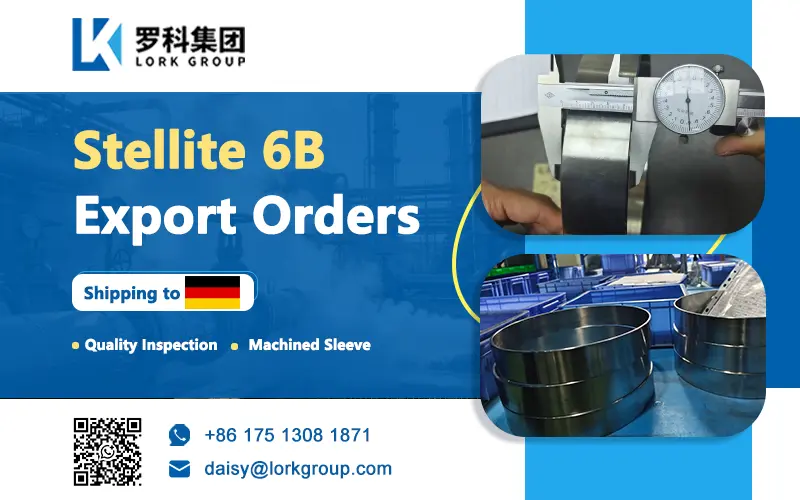
The Lork Group possesses extensive experience in processing cobalt-based alloys and maintains a comprehensive quality control system. The Stellite 6B bushings exported in this shipment—measuring 9 cm in width and 36 cm in diameter—are high-precision components. Delivery takes place only after the products have passed inspection; this process reflects our unwavering commitment to quality and is key to earning the trust of our German clients.
Lork Group Stellite 6B machined bushings exported to Germany

As an international group with 15 years of experience in specialty alloy supply chain management, Lork Group offers product selection consultation and supply services for the full range of Elgiloy, Pyromet, Elinvar, and Ni-Span-C 902 alloys. Please feel free to contact Lork Group’s sales and technical teams for the latest price quotes, material technical data sheets, or supplier coordination support.
Supplier of Elgiloy Pyromet Elinvar and Ni-Span-C 902 high-elasticity alloys
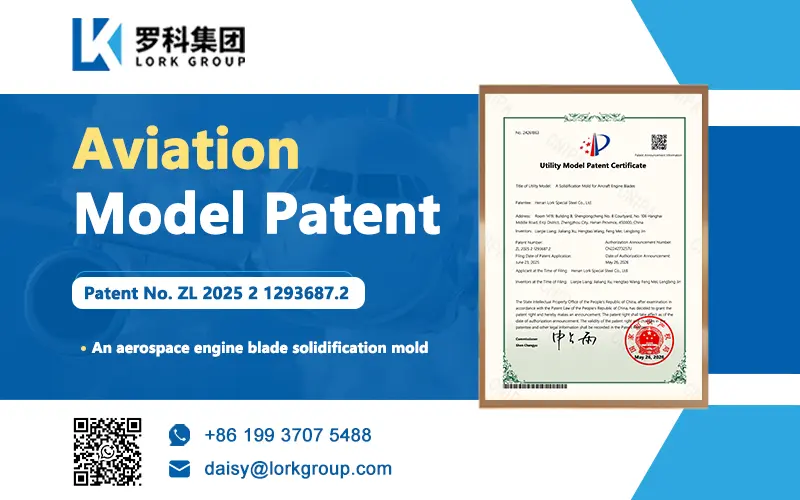
Patent No. ZL 2025 2 1293687.2 focuses on the precision casting of aero-engine blades, demonstrating the Group's sustained innovation capabilities in the fields of specialty steels and precision forming technologies.
Lork Group Granted National Utility Model Patent for an Aviation Engine Blade Solidification Mold