Lork Group's Medical Titanium Alloy Implants Solve the Challenge of Stress Shielding
An overlooked clinical issue
This phenomenon is known as the "stress shielding" effect.
When the elastic modulus of a metal implant is significantly higher than that of the surrounding bone, the implant "usurps" the mechanical loads that the bone should be bearing. Deprived of sufficient mechanical stimulation, the bone gradually atrophies—a direct manifestation of Wolff's Law. Clinical studies indicate that with high-modulus cobalt-chromium-molybdenum alloy prostheses, the incidence of periprosthetic bone loss can reach 43%–85% within 11 to 12 years post-surgery.
The Evolution of Materials: From "Functional" to "User-Friendly"
The Ti-13Nb-13Zr alloy supplied by the Lork Group (compliant with the ASTM F1713 standard) is a prime example of this third-generation material. It features an elastic modulus of approximately 79 GPa—about 30% lower than that of traditional Ti-6Al-4V—and is free from potentially toxic elements such as aluminum and vanadium. Research further indicates that solution treatment can reduce the alloy's elastic modulus to 49 GPa, bringing it even closer to the natural characteristics of human bone.
What does this mean for purchasers? In short: a lower elastic modulus translates to more uniform load transfer, reduced bone resorption, and a longer service life for the implant.
Lork Group’s Product Portfolio: Medical-Grade Titanium Alloys Covering All Application Scenarios
| Material Category | Representative Grade | Standard | Modulus of Elasticity | Typical Medical Applications | Core Advantages |
|---|---|---|---|---|---|
|
Commercially pure titanium
|
ASTM F67 | ~100-105 GPa | Dental implants, bone plates, craniomaxillofacial prostheses, bone screws | Excellent corrosion resistance, good biocompatibility, and good processability. | |
|
(α+β)-type alloy
|
ASTM F136 | ~110 GPa | Artificial hip stems, knee joint components, spinal fixation systems, bone screws | High strength, good fatigue performance, and the most well-established clinical application. | |
|
|
ASTM F1295 | ~105 GPa | Hip joint prostheses, fracture fixation plates, intramedullary nails | Niobium replaces vanadium, offering superior biocompatibility and no potential cytotoxicity. | |
| β-type alloy | Ti-13Nb-13Zr | ASTM F1713 | ~79 GPa (can reach 49 GPa after solution treatment) | Hip stems, spinal fusion cages, long-term implants | Low elastic modulus, reducing stress shielding; free of aluminum and vanadium, with excellent biocompatibility. |
| ASTM F2066 | ~78 GPa | Orthopedic implants, cardiovascular stents | Low modulus, high corrosion resistance, good processability | ||
| TMZF(Ti-12Mo-6Zr-2Fe) | ASTM F1813 | ~74-80 GPa | Hip stems, knee prostheses | Low modulus, high strength, excellent fatigue performance |


Recommendations for Engineering Procurement
● First, the application scenario must be clearly defined:
For load-bearing components (such as hip stems and spinal fusion cages), fatigue strength and fracture toughness are the primary considerations, making Ti-6Al-4V ELI a proven and reliable choice. In contrast, low-modulus beta-titanium alloys offer distinct advantages for long-term implants where minimizing the stress shielding effect is required.
● Focus on standards and certifications:
Medical-grade titanium alloys must comply with ASTM or ISO standards (such as ISO 13485; the Lork Group holds the original certification, which was specifically obtained for medical materials and users in this sector). When procuring these materials, suppliers should be required to provide a complete Mill Test Certificate to verify that the chemical composition, mechanical properties, and microstructure meet the specified requirements.
● Consider manufacturing process compatibilit:
If 3D printing is the intended manufacturing method, the suitability of the powder or substrate must be verified. For users requiring custom-made finished components, the Lork Group offers extensive experience in titanium alloy rods for spinal screws; its products feature shrinkage control within 0.03 mm and precisely tunable microstructures, meeting the demands of precision machining.
Lork Steels: Specializing in Medical Titanium Alloy Supply
WhatsApp: +86 175 1308 1871
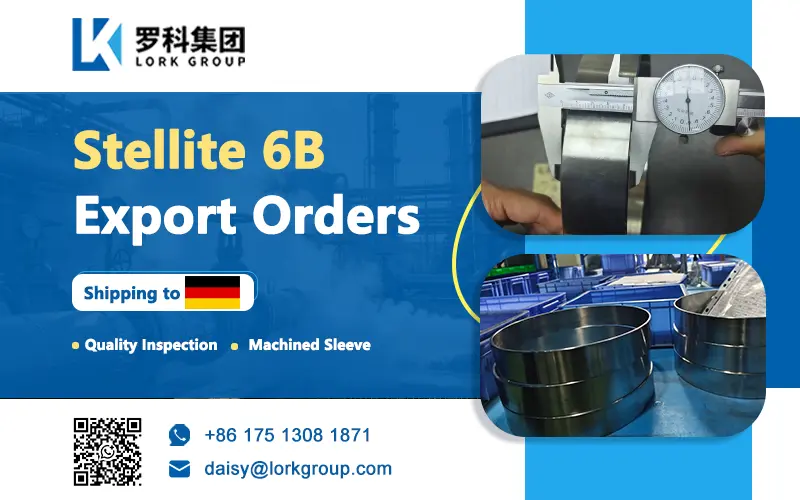
Lork Group Stellite 6B machined bushings exported to Germany
Related Article