
17-7PH vs 17-4PH - How to Choose Stainless Steel Strip
2026-05-27
Introduction
Simply put, if your application involves manufacturing components such as springs or washers—which require high elasticity and high fatigue strength—you should choose 17-7PH. Conversely, if you need to fabricate structural components capable of withstanding heavy loads, and are sensitive to cost, 17-4PH represents a more established and widely utilized choice.
Both materials belong to the family of precipitation-hardening stainless steels, yet they prioritize different core performance characteristics.
Differences in Composition and Metallurgical Structure
This constitutes the fundamental basis for the performance differences between 17-4PH and 17-7PH:
- 17-4PH (Martensitic): The primary strengthening elements are copper (Cu) and niobium (Nb). It is a quintessential martensitic precipitation-hardening stainless steel, strengthened through heat treatment by precipitating copper-rich phases within a martensitic matrix.
- 17-7PH (Semi-austenitic): The primary strengthening element is aluminum (Al). Initially possessing an austenitic structure, it undergoes a transformation into martensite via a specialized heat treatment process (high-temperature solution treatment followed by a conditioning treatment), and is subsequently strengthened through the precipitation of the Ni3Al phase (a nickel-aluminum intermetallic compound).
Comparison of Mechanical Properties
For stainless steel strips, strength and hardness are key indicators.
| Performance Metrics | 17-4PH (After Age Hardening) | 17-7PH (After Age Hardening) | Conclusion and Analysis |
|---|---|---|---|
| Tensile Strength | Approx. 930 – 1310 MPa (depending on aging temperature) | Up to 1650 – 2515 MPa (in the CH900 condition) | 17-7PH significantly outperforms 17-4PH. 17-7PH is currently one of the highest-strength grades among commercially available stainless steel strips, making it particularly well-suited for thin-walled, high-stress springs. |
| Yield Strength | Approx. 325 – 1180 MPa | Extremely high; typically exhibits a very high ratio relative to tensile strength. | 17-7 PH is even higher. This implies that it is more resistant to permanent deformation. |
| Hardness (HRC) | Approx. 28–40 (depending on aging temperature) | Up to 38–48 (or even higher) | 17-7PH is harder. 17-7PH offers superior wear resistance, but cold forming processes (such as stamping and bending) are relatively difficult. |
| Elongation (Plastic) | Good (Typically ≥ 10%) | Poor (Typically ≤ 5% after aging) | 17-4PH is superior. 17-4PH possesses better toughness, enabling it to withstand greater plastic deformation without cracking. |
| Lork Group Products |
|
- |


Typical Application Scenarios (Strip)
| Application Fields | 17-4PH Stainless Steel Strip | 17-7PH Stainless Steel Strip |
|---|---|---|
| Preferred Applications | High-strength structural components, bushings, gears, valves, flanges, chemical equipment, oilfield components | High-stress springs, diaphragms, bellows, washers, fasteners, aerospace components |
| Scenarios Not Recommended | Environments with operating temperatures exceeding 300°C | Complex deep-drawn parts (due to excessive hardness and brittleness) |
Corrosion Resistance and Operating Temperature
Corrosion Resistance:
Both grades demonstrate excellent performance in most environments, surpassing martensitic stainless steels such as 410 and 420.
In the aged condition, 17-4PH typically exhibits superior resistance to intergranular corrosion and pitting corrosion compared to 17-7PH.
Following high-temperature aging (e.g., CH900), the corrosion resistance of 17-7PH declines to a level comparable to that of 304 stainless steel.
In the aged condition, 17-4PH typically exhibits superior resistance to intergranular corrosion and pitting corrosion compared to 17-7PH.
Following high-temperature aging (e.g., CH900), the corrosion resistance of 17-7PH declines to a level comparable to that of 304 stainless steel.
Operating Temperature:
17-4PH: Recommended for long-term service at temperatures below 300°C (572°F), making it suitable for moderate-to-low temperature environments.
17-7PH: Possesses superior high-temperature stress-rupture properties, with an applicable temperature range extending up to 600°F (316°C); furthermore, it demonstrates better retention of elastic properties at elevated temperatures.
Summary of Insights and Recommendations
- Choose 17-7PH: If your primary requirements are "high strength" and "high elasticity"—for instance, if you need to fabricate extremely thin spring strips, or if you require excellent resilience retention at elevated temperatures around 316°C—then 17-7PH is the more specialized choice, even though it typically entails greater processing difficulty and higher costs.
- Choose 17-4PH: If you require a component with "well-rounded performance"—possessing not only high strength but also a degree of toughness and corrosion resistance (such as in marine environments or acidic media)—and if you are sensitive to cost considerations, then 17-4PH is the preferred option; it enjoys wider application within the industrial sector and benefits from a more mature supply chain.
Lork Steels: Specializing in High-Performance Alloy Supply
If you require a more detailed data sheet regarding the properties of 17-4ph or 17-7ph stainless steel strip, or would like to request a quotation, please visit our Product Center directly or consult with one of our online engineers.
Operations & Marketing Department | Director of Operations
Email: dasiy@lorkgroup.com
WhatsApp: +86 175 1308 1871
WhatsApp: +86 175 1308 1871
Silent Guardian of the Deep - Precision Titanium Alloy for Submarine Sonar Domes
NIMONIC Alloys-Extreme High-Temperature and Corrosive Applications
Related Article

The Lork Group specializes in providing stress shielding solutions for users of titanium alloy orthopedic implants. Our materials include ASTM F1713 titanium rods, Ti-13Nb-13Zr titanium alloy, and other ASTM F1713 titanium products.
Lork Group's Medical Titanium Alloy Implants Solve the Challenge of Stress Shielding
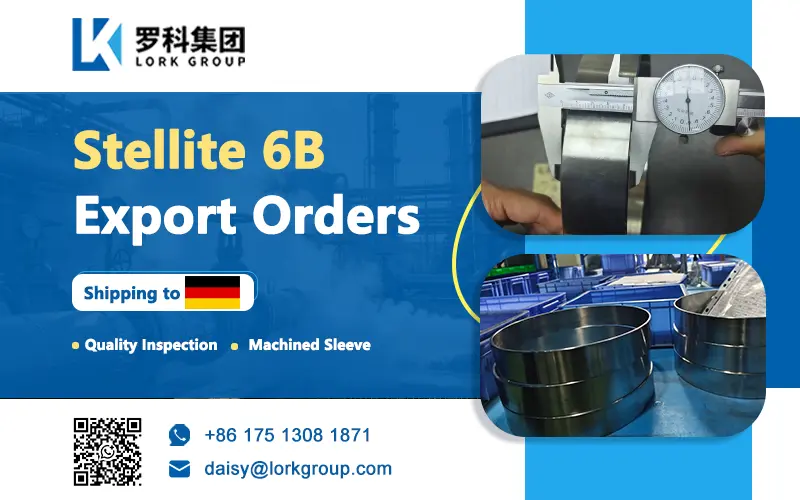
The Lork Group possesses extensive experience in processing cobalt-based alloys and maintains a comprehensive quality control system. The Stellite 6B bushings exported in this shipment—measuring 9 cm in width and 36 cm in diameter—are high-precision components. Delivery takes place only after the products have passed inspection; this process reflects our unwavering commitment to quality and is key to earning the trust of our German clients.
Lork Group Stellite 6B machined bushings exported to Germany

As an international group with 15 years of experience in specialty alloy supply chain management, Lork Group offers product selection consultation and supply services for the full range of Elgiloy, Pyromet, Elinvar, and Ni-Span-C 902 alloys. Please feel free to contact Lork Group’s sales and technical teams for the latest price quotes, material technical data sheets, or supplier coordination support.
Supplier of Elgiloy Pyromet Elinvar and Ni-Span-C 902 high-elasticity alloys
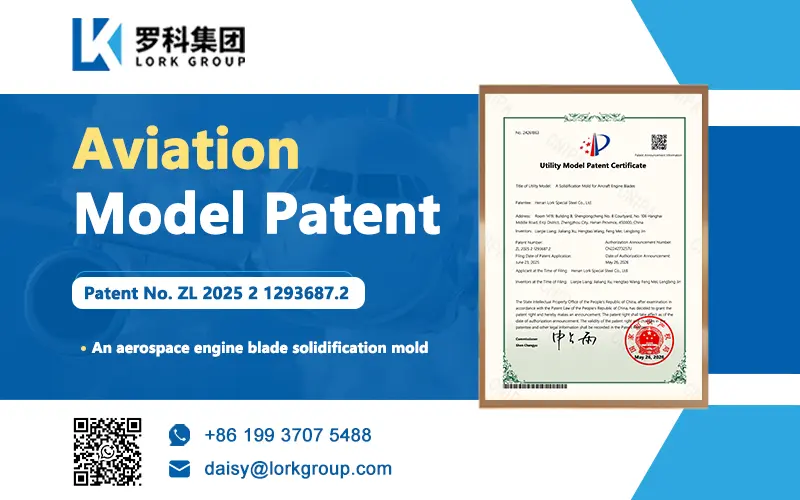
Patent No. ZL 2025 2 1293687.2 focuses on the precision casting of aero-engine blades, demonstrating the Group's sustained innovation capabilities in the fields of specialty steels and precision forming technologies.
Lork Group Granted National Utility Model Patent for an Aviation Engine Blade Solidification Mold