
Application of titanium alloy in biomedical field
2024-09-14
Titanium and titanium alloys are widely used in various biomedical treatment scenarios, including joint and bone replacement, craniofacial and dental implants, surgical instruments, healthcare products, or external and internal prostheses. The usage of titanium alloy in the entire human medical device and the specifications of titanium alloy used in medical devices are shown in Figure 1.

Arthroplasty and bone replacement
Titanium is widely used in the entire human musculoskeletal structure. The most common biomedical applications of titanium are hip and knee replacement, followed by shoulder and elbow implants. Titanium is also commonly used in the field of spine, including spinal correction components, spinal fixation devices, spinal fusion devices, and in recent years, intervertebral disc replacement. The rib cage made of titanium for children can expand the implant as the body grows, allowing young patients to grow together with the ribs.
Finger and toe implants, as well as tibial nails used to reinforce lower leg fractures, are also made of titanium. Nowadays, fixation and reconstruction devices are often used to support fractured bones, such as titanium bone plates, nets, needles, screws, and rods. In order to extend the lifespan of implants for young patients, some applications utilize rough bioactive surfaces to limit absorption and stimulate bone integration.
Craniofacial and Maxillofacial Applications
The application of titanium in neurosurgery and cranioplasty includes skull plates, mesh structures, and acrylic acid. The biocompatibility of titanium helps with faster recovery and reduces the chance of infection. Maxillofacial prostheses made of titanium alloys with appropriate levels of biocompatibility, strength, and osseointegration can stabilize soft tissue prostheses. The application of maxillofacial prostheses after maxillofacial surgery may often be necessary to restore the patient's aesthetic appearance, ability to eat or speak, and replace any missing facial features due to illness or accident injuries. Figure 2 provides a brief description of the design and manufacturing process of a patient specific mandibular prosthesis implant for addressing clinical application related deficiencies in the maxillofacial region.

Dental implants
Titanium alloy is used as a dental implant in dental restoration practice, serving as an artificial tooth root and providing a solid foundation from a single tooth to a complete dental arch. Titanium tooth roots include biocompatible anchors that are implanted into the jawbone through surgery. Once the bone integration period occurs, the natural tooth loses its ability to support the artificial crown. During this period, the bones will grow into titanium implants and surround them to form a strong structural support. Afterwards, use adhesive or screw fastening methods to connect the upper tooth structure components as tooth substitutes to the implant. Orthodontics made of titanium alloy are lighter, stronger, and more biocompatible than steel. In this regard, pure titanium, Ti-6Al-4V, and Ti-6Al-7Nb are the main titanium alloys used in surgical and dental applications. Figure 3 lists the mechanical properties of various titanium alloys used in dental applications.

The casting process is crucial for the dental application of titanium, with a focus on low elongation and high strength. Hydrogenation treatment and dehydrogenation treatment are effective techniques for increasing elongation without compromising the strength of cast titanium alloys. These include thermochemical treatment through post heat treatment (such as crushing structures or treatment with beta and alpha beta solutions). Titanium alloys have a higher melting point and are more reactive than other dental alloys, such as Ag and Au based alloys, which are the preferred choice for precision dental castings.
External prosthesis
Due to its inherent characteristics such as corrosion resistance, light weight, and toughness, titanium alloys are widely used in the manufacture of temporary or long-term external devices and fixed devices, including prosthetics and orthopedic calipers.
Internal prosthesis
Titanium alloy nails are used to fix false ears and eyes, while pure titanium mesh implants are used to fix orbital fractures. The auditory applications of titanium include bone conduction hearing aids fixed with titanium devices and connected to the middle ear.
The carrier structure for replacing heart valves, coronary angioplasty catheters, defibrillators, endovascular stents, pacemaker boxes, and vascular access ports are also made of titanium alloy. The infusion pump uses titanium nickel shape memory alloy, which bends when an electric current is applied, creating heating and cooling cycles that change the shape of the cavity. Urethral stricture can be treated with a titanium urethral stent.
Surgical instruments
Due to its antibacterial, corrosion-resistant, radiation resistant, durable, and lightweight properties, various surgical instruments such as dental drills, forceps, and laser electrodes typically contain titanium. Titanium is lightweight, reducing the fatigue experienced by surgeons during prolonged use of instruments. For microsurgery procedures such as ophthalmic surgery, titanium surgical instruments are typically anodized to create the necessary non reflective surface for such surgeries. The non-magnetic nature of titanium reduces the possibility of electromagnetic damage or interference to small sensitive implants during surgery. The durability of titanium surgical instruments enables them to withstand repeated sterilization cycles without compromising their corrosion resistance, strength, edge quality, and surface quality.
Application in healthcare products
The application of titanium alloys in healthcare products is constantly expanding. Due to its excellent biocompatibility, low weight, and high strength characteristics, these applications include external prosthetics and wheelchairs, especially those used for sports purposes. The widely used titanium alloys in this regard are TFCA (Ti-4.0Fe-6.7Cr-3.0Al) and TFC (Ti-4.2Fe-6.9Cr), as their costs are lower than pure titanium, as the recovery of titanium containing iron (Fe) or low-cost chromium iron (FeCr) can be used for this purpose.
Even if healthcare products are not implanted in patients, biocompatibility issues such as allergic reactions still need to be addressed, especially for elderly individuals with weaker immune systems who are more inclined to use these healthcare devices. A study involving pure titanium, Ti-6Al-4V, TFC, and TFCA showed that TFC and TFCA had higher cell viability in each group. Therefore, TFC and TFCA may be more widely applied in other types of healthcare products.
Hastelloy C276 widely used in the pulp and paper industry
The most common alloy material used for surgical instruments
Related Article

The Lork Group specializes in providing stress shielding solutions for users of titanium alloy orthopedic implants. Our materials include ASTM F1713 titanium rods, Ti-13Nb-13Zr titanium alloy, and other ASTM F1713 titanium products.
Lork Group's Medical Titanium Alloy Implants Solve the Challenge of Stress Shielding

The Lork Group possesses extensive experience in processing cobalt-based alloys and maintains a comprehensive quality control system. The Stellite 6B bushings exported in this shipment—measuring 9 cm in width and 36 cm in diameter—are high-precision components. Delivery takes place only after the products have passed inspection; this process reflects our unwavering commitment to quality and is key to earning the trust of our German clients.
Lork Group Stellite 6B machined bushings exported to Germany

As an international group with 15 years of experience in specialty alloy supply chain management, Lork Group offers product selection consultation and supply services for the full range of Elgiloy, Pyromet, Elinvar, and Ni-Span-C 902 alloys. Please feel free to contact Lork Group’s sales and technical teams for the latest price quotes, material technical data sheets, or supplier coordination support.
Supplier of Elgiloy Pyromet Elinvar and Ni-Span-C 902 high-elasticity alloys
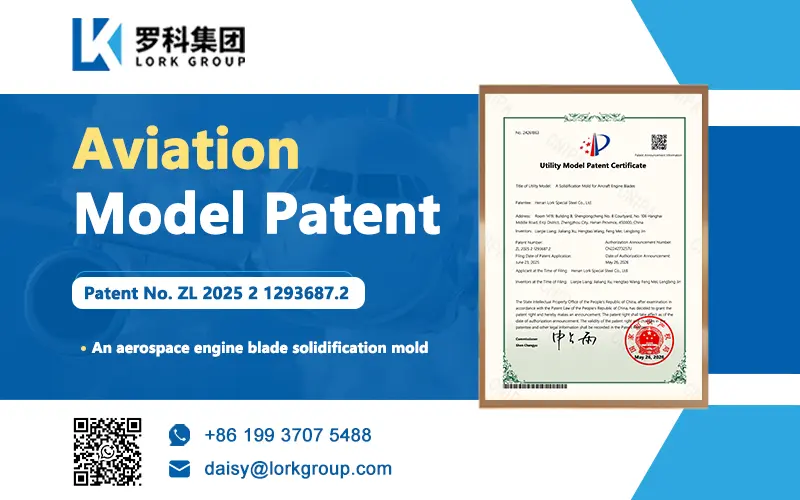
Patent No. ZL 2025 2 1293687.2 focuses on the precision casting of aero-engine blades, demonstrating the Group's sustained innovation capabilities in the fields of specialty steels and precision forming technologies.
Lork Group Granted National Utility Model Patent for an Aviation Engine Blade Solidification Mold