
How to choose 1j22 VS 1j50 soft magnetic alloy?
2025-10-11
The difference between 1j22 and 1j50 soft magnetic alloys
1J22 and 1J50 are two widely used soft magnetic alloys. They have obvious differences in core properties and application areas. To help you quickly understand, I have summarized their main differences in a table:
Precision alloys specifically refer to alloys that possess specialized physical properties (such as magnetic, thermal, electrical, and elastic) rather than purely mechanical properties.
Precision alloys specifically refer to alloys that possess specialized physical properties (such as magnetic, thermal, electrical, and elastic) rather than purely mechanical properties.
| Comparison Dimension | 1J22 (Iron-Cobalt-Vanadium Alloy) | 1J50 (iron-nickel alloy) |
| Alloy Type | High saturation magnetic induction soft magnetic alloy | Fe-Ni soft magnetic alloy (Permalloy) |
| Core Features | High saturation magnetic flux density (2.4T), high Curie point (980°C), and large magnetostriction coefficient | High magnetic permeability, high magnetic flux density at moderate magnetic fields, low coercivity, and low losses |
| Key Magnetic Properties | Saturation Magnetic Induction (Bs): ≈2.4 T Curie Temperature (Tc): ≈980°C Resistivity: Approximately 0.27 μΩ·m |
Saturation Magnetic Induction (Bs): ≈1.5 T Initial Permeability (μi): High (typical value ≥11.5 mH/m) |
| Typical Applications | Electromagnetic pole heads, magnetostrictive transducers, aerospace micromotors | Transformer cores operating in medium magnetic fields, magnetic shields, and relays |
| Processability | Poor processability, prone to oxidation, and relatively expensive | High elongation and good processability |
If you are interested in the stock and custom products of the two soft magnetic alloys 1j22 VS 1j50, please contact us.
Selection and Application Recommendations
The decision between these two alloys depends primarily on your core requirements:
For "strength" and "high-temperature stability," choose 1J22:
If your design prioritizes high magnetic flux density, high torque output, or magnetic stability in high-temperature environments, 1J22 is more suitable. Examples include:
- Electromagnet poles
- High-power magnetostrictive transducers
- Aerospace applications require compact, high-power motor components.
Note that 1J22 is difficult and expensive to process, and its low resistivity makes it unsuitable for high-frequency use.
Choose 1J50 for "both sensitivity" and "efficiency":
If your design focuses on achieving high magnetic flux density, high permeability, and low energy loss in moderate magnetic fields, 1J50 is a more universal and economical choice. Typical applications include:
- Various transformer cores
- Magnetic shielding materials
- Relay cores
- Computer device components.
It also offers improved processing performance.
Processing Tips and Specifications
1J22 Processing Warning:
As mentioned above, 1J22 has poor processability and is susceptible to oxidation. Its heat treatment process is complex, typically requiring multiple annealing stages under hydrogen protection.
1J50 Processability:
1J50 Processability:
1J50 offers excellent processability. It is available in a variety of hardnesses, including soft, full hard, and medium hard.
The following are the specifications and sizes of soft magnetic alloys available from the Lork Group:
1J22:
Common cold-rolled strip thicknesses range from 0.05mm to 1.00mm, and hot-rolled (forged) flats and bars range in thickness or diameter from 6.0mm to 100.0mm.
1J50:
1J50:
Strip thicknesses range from an extremely thin 0.001mm to 4mm, with widths up to 1550mm.
Lork Group's soft magnetic alloy hot-selling materials


To learn more, please contact us.
WhatsApp: +86 17513081871
Email:Daisy@lorkgroup.com
Congratulations to Lork Group on successfully passing the ISO triple certification.
"Biometal" Medical Grade Titanium Alloy-Lork Group
Related Article
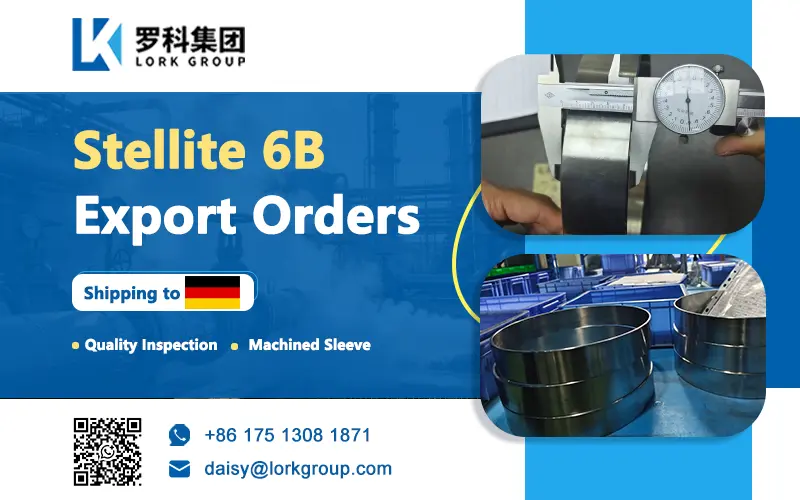
The Lork Group possesses extensive experience in processing cobalt-based alloys and maintains a comprehensive quality control system. The Stellite 6B bushings exported in this shipment—measuring 9 cm in width and 36 cm in diameter—are high-precision components. Delivery takes place only after the products have passed inspection; this process reflects our unwavering commitment to quality and is key to earning the trust of our German clients.
Lork Group Stellite 6B machined bushings exported to Germany

As an international group with 15 years of experience in specialty alloy supply chain management, Lork Group offers product selection consultation and supply services for the full range of Elgiloy, Pyromet, Elinvar, and Ni-Span-C 902 alloys. Please feel free to contact Lork Group’s sales and technical teams for the latest price quotes, material technical data sheets, or supplier coordination support.
Supplier of Elgiloy Pyromet Elinvar and Ni-Span-C 902 high-elasticity alloys
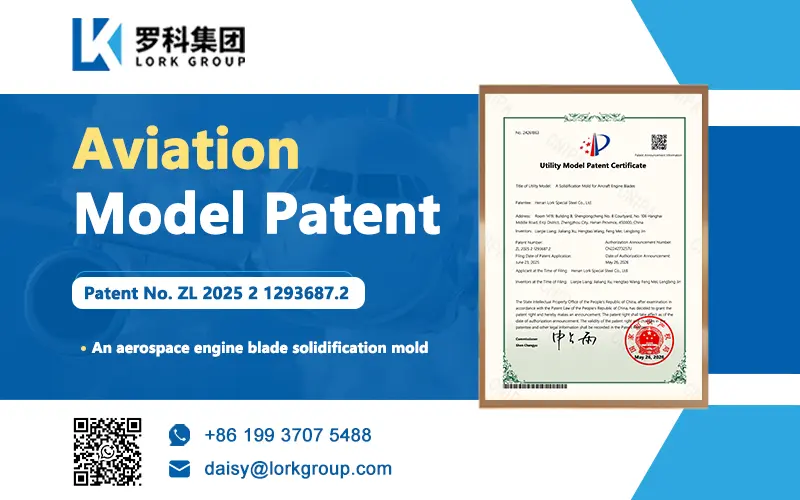
Patent No. ZL 2025 2 1293687.2 focuses on the precision casting of aero-engine blades, demonstrating the Group's sustained innovation capabilities in the fields of specialty steels and precision forming technologies.
Lork Group Granted National Utility Model Patent for an Aviation Engine Blade Solidification Mold
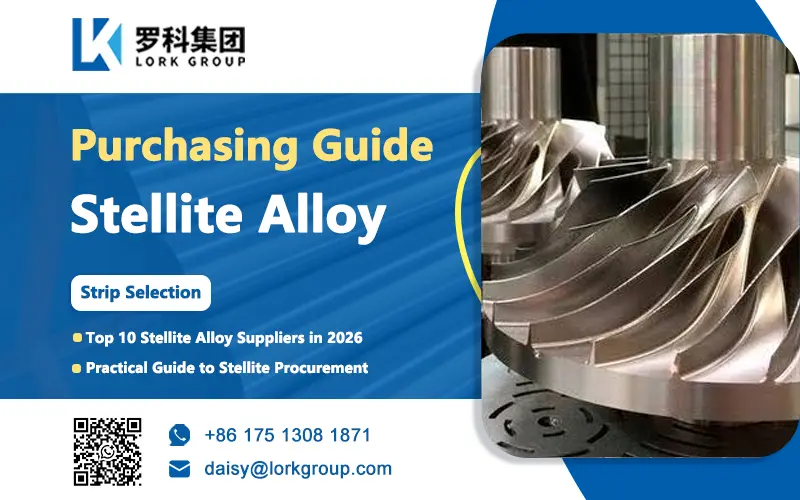
If you are unsure whether to use Stellite 6, 12, or 21 for your current project, simply send us a description of the operating conditions, and Lork Group engineers will provide a free "grade recommendation." Click the button below to submit details regarding operating temperature, corrosive media, and impact conditions, and we will respond within 24 hours.
Top 10 Suppliers of Stellite Alloy Materials for 2026