Lork Group Co., Ltd
    qr Code Url

    Scan qrcode to view mobile website

    Home /Blog /Alloy Knowledge /Non-Destructive Testing (NDT): Ensuring Quality Without Compromising Integrity /

    Non-Destructive Testing (NDT): Ensuring Quality Without Compromising Integrity

    2025-05-08

    What is Non-Destructive Testing (NDT)?

    Non-Destructive Testing (NDT) is a critical evaluation method used to inspect materials, components, and structures without causing damage. Unlike destructive testing, which involves breaking or altering a sample, NDT allows manufacturers, engineers, and quality control specialists to assess the integrity, reliability, and performance of materials while keeping them fully functional.
    At Lork Group, we utilize advanced NDT techniques to ensure that our high-performance metals meet stringent industry standards before they are deployed in demanding environments such as oil & gas, aerospace, power generation, and marine applications.

    Why is Non-Destructive Testing Important?

    NDT plays a vital role in quality assurance, safety, and cost-efficiency across multiple industries. By detecting flaws early—such as cracks, corrosion, voids, or inconsistencies—NDT helps prevent catastrophic failures, unplanned shutdowns, and costly repairs.
    Key Benefits of NDT:
    ✔ Preserves Material Integrity – No damage is done to the tested product.
    ✔ Cost-Effective – Eliminates the need for extra samples, reducing waste.
    ✔ Immediate Results – Rapid inspections enable quick decision-making.
    ✔ Enhances Safety – Identifies hidden defects that could lead to failures.
    ✔ Compliance with Standards – Ensures materials meet ASTM, ASME, ISO, and other regulatory requirements.

    Common Non-Destructive Testing Methods

    NDT encompasses a variety of techniques, each suited for different materials and defect types. Some of the most widely used methods include:

    1. Dye Penetrant Inspection (DPI)

    • Used to detect surface cracks in non-porous materials (metals, plastics, ceramics).
    • A colored or fluorescent dye is applied, seeps into defects, and reveals flaws under UV light.

    2. Magnetic Particle Inspection (MPI)

    • Effective for ferrous metals (iron, nickel, cobalt alloys).
    • Uses a magnetic field to highlight surface and near-surface defects.

    3. Ultrasonic Testing (UT)

    • Uses high-frequency sound waves to detect internal flaws and measure material thickness.
    • Ideal for welds, pipelines, and structural components.

    4. Radiographic Testing (RT)

    • Employs X-rays or gamma rays to inspect internal structures.
    • Commonly used in welding inspections and aerospace components.

    5. Thermal/Infrared Testing

    • Measures temperature variations to identify cracks, delamination, or insulation defects.
    • Useful in electrical systems and composite materials.

    6. Ferrite Testing

    • Measures ferrite content in stainless steel to prevent cracking or corrosion issues.
    • Critical for welded structures in chemical and marine environments.

    7. Visual Inspection (VT)

    • The simplest yet essential NDT method, performed by trained inspectors.
    • Identifies surface defects, corrosion, and inconsistencies.

    Industries That Rely on NDT

    NDT is indispensable in sectors where safety, durability, and precision are paramount:
    • Oil & Gas – Pipeline inspections, refinery equipment.
    • Aerospace – Aircraft engines, structural components.
    • Power Generation – Turbine blades, nuclear reactors.
    • Marine & Shipbuilding – Hull inspections, offshore platforms.
    • Automotive – Engine parts, welded joints.
    • Construction – Bridges, pressure vessels, steel structures.
    Non-Destructive Testing is a cornerstone of quality assurance, enabling industries to verify material performance without destruction. Ensure quality, safety, and longevity—choose advanced NDT and premium materials for your next project! ?
      
    Share:

    Seamless vs. Welded vs. Forged Pipes: How to Choose the Right Type for Your Project

    Properties of Titanium Material Grades

    Related Article

    image
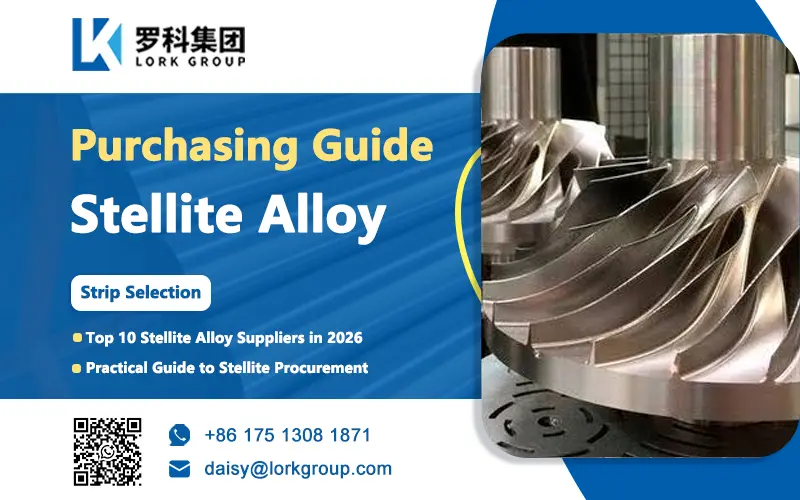
    If you are unsure whether to use Stellite 6, 12, or 21 for your current project, simply send us a description of the operating conditions, and Lork Group engineers will provide a free "grade recommendation." Click the button below to submit details regarding operating temperature, corrosive media, and impact conditions, and we will respond within 24 hours.
    Top 10 Suppliers of Stellite Alloy Materials for 2026
    2026-07-20
    image
    To meet the demand for metallurgical equipment and industrial furnaces in post-war industrial reconstruction, Lork Group supplies nickel alloy components—including high-temperature furnace tubes (for sulfur-containing atmospheres), radiant tubes (for carburizing environments), combustion chamber liners, fasteners, and springs.
    Nickel Alloys for Core Applications in Metallurgical Equipment and Industrial Furnaces
    2026-06-24
    image
    Rapidly responding to sample requests from Italian clients—demonstrating the Lork Group's export capabilities for Kovar alloy tubes.
    Shipment Record Kovar Tubes Exported to Italy Lork Group
    2026-06-18
    image
    We supply precision titanium alloys for submarine sonar domes, applying a rigorous material selection logic and comprehensive process control.
    Silent Guardian of the Deep - Precision Titanium Alloy for Submarine Sonar Domes
    2026-06-09
    Lork Group

    Contact Us

    TEL: +86-17513081871

    E-mail: daisy@lorkgroup.com

    WhatsApp: +86-1751308187

    PRODUCTS

    Inconel

    Hastelloy

    Haynes

    Monel

    Incoloy

    Nimonic

    China GH Series

    Heat Resistant Steel

    Other Superalloy

    Duplex Stainless Steel

    600 Series Stainless Steel

    300 Series Stainless Steel

    Corrosion-Resistant

    Precision Alloy

    SiteMap

    Copyright © 2024 Lork Group Co., Ltd

    京公网安备 32058302002032号

    (434834)
    0