
Home /Blog /Alloy Knowledge /The Advantages of Titanium Plates (Gr1-Gr4) in Surgical Instrument Manufacturing /
The Advantages of Titanium Plates (Gr1-Gr4) in Surgical Instrument Manufacturing
2025-05-22
In the medical field, surgical instruments must meet stringent requirements for durability, biocompatibility, and precision. Titanium, particularly in grades 1 through 4 (Gr1-Gr4), has become a preferred material for manufacturing high-performance surgical tools due to its exceptional properties. Manufacturers specializing in titanium plates for surgical instruments ensure strict quality control, adhering to international standards to deliver products with precise tolerances.
| Gr1, Gr2,Gr3 and Gr4 titanium plate for surgical instrument | |
| Material | Gr1, Gr2,Gr3 and Gr4 |
| Standard | ASTM F67, IS05832-2 |
| Regular Size | (0.6~8) T * (300~400) W * (1000~1200 )L mm or customized size |
| Thickness tolerance | 0.05-0.3 mm |
| State | M, Annealed |
| Surface Condition | Acid washing, Polished we offered |
| Test | With mill test certificate, accept the third party test. |
Chemical composition
|
Grade |
Ti |
Chemical composition (%) | ||||||
|
Impurity(%) Max |
Residual elements |
|||||||
|
Fe |
C |
N |
H |
O |
Single |
Total |
||
|
Gr1 |
Bal |
0.20 |
0.08 |
0.03 |
0.015 |
0.18 |
0.10 |
0.40 |
|
Gr2 |
Bal |
0.30 |
0.08 |
0.03 |
0.015 |
0.25 |
0.10 |
0.40 |
|
Gr3 |
Bal |
0.30 |
0.08 |
0.05 |
0.015 |
0.35 |
0.10 |
0.40 |
|
Gr4 |
Bal |
0.50 |
0.08 |
0.05 |
0.015 |
0.40 |
0.10 |
0.40 |
Mechanical property
|
Material |
Condition |
Thickness mm |
Mechanical Property |
||
|
Tensile strength Rm/Mpa |
Yield strength Rp0.2/Mpa |
Elongation A% |
|||
|
Gr1 |
M |
<25 |
Min 240 |
Min 170 Max 310 |
Min 24 |
|
Gr2 |
M |
<25 |
Min 345 |
Min 275 Max 450 |
Min 20 |
|
Gr3 |
M |
<25 |
Min 450 |
Min 380 Max 550 |
Min 18 |
|
Gr4 |
M |
<25 |
Min 550 |
Min 438 Max 660 |
Min 15 |
Why Titanium for Surgical Instruments?
1. Lightweight Yet Durable
Titanium is significantly lighter than stainless steel, reducing fatigue for surgeons during lengthy procedures. Despite its lightweight nature, titanium offers excellent strength, making it ideal for precision surgical tools that require both resilience and maneuverability.
2. Superior Biocompatibility
One of titanium's most critical advantages is its biocompatibility. Grades 1 through 4 are highly resistant to corrosion and do not react adversely with human tissues or bodily fluids, minimizing the risk of inflammation or rejection. This makes titanium plates an excellent choice for implants and reusable surgical instruments.
3. Corrosion Resistance
Titanium naturally forms a protective oxide layer when exposed to oxygen, preventing rust and degradation even in harsh sterilization processes such as autoclaving. This ensures long-term usability and reduces the need for frequent replacements.
4. Precision Manufacturing
Suppliers of Gr1-Gr4 titanium plates maintain strict quality control, ensuring that each plate meets exact dimensional tolerances. This precision is crucial for surgical instruments, where even minor deviations can impact performance.
Applications of Titanium Plates in Surgical Instruments
- Bone Saws and Drills – Titanium’s strength and lightness make it ideal for orthopedic tools.
- Forceps and Clamps – Biocompatibility ensures safe contact with tissues.
- Scalpel Handles – Lightweight design enhances precision and control.
- Retractors and Needle Holders – Corrosion resistance ensures longevity.
Titanium plates (Gr1-Gr4) are revolutionizing surgical instrument manufacturing by offering an optimal balance of strength, weight, and biocompatibility. With rigorous quality control and adherence to international standards, manufacturers provide high-precision titanium plates that meet the demanding needs of modern surgery. As medical technology advances, titanium will continue to play a vital role in improving surgical outcomes and patient safety.
By choosing titanium-based instruments, healthcare providers invest in reliability, durability, and superior performance—essential qualities in life-saving medical tools.
Request a Free Quote Today! Contact Lork Group for certified titanium plates, sheets, and custom machining services. Partner with a leading titanium supplier for durability, performance, and excellence.
MP159 Superalloy Material Properties
The Advantages of Titanium Bars in Hip Joint Implants
Related Article
The Lork Group specializes in providing stress shielding solutions for users of titanium alloy orthopedic implants. Our materials include ASTM F1713 titanium rods, Ti-13Nb-13Zr titanium alloy, and other ASTM F1713 titanium products.
Lork Group's Medical Titanium Alloy Implants Solve the Challenge of Stress Shielding
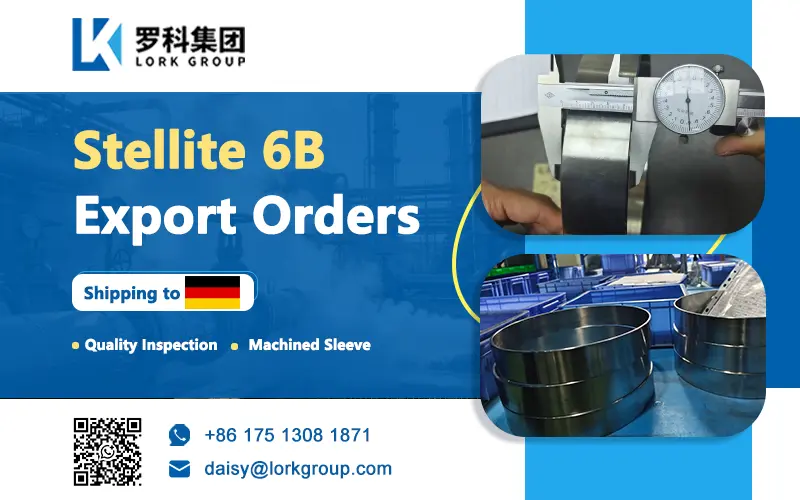
The Lork Group possesses extensive experience in processing cobalt-based alloys and maintains a comprehensive quality control system. The Stellite 6B bushings exported in this shipment—measuring 9 cm in width and 36 cm in diameter—are high-precision components. Delivery takes place only after the products have passed inspection; this process reflects our unwavering commitment to quality and is key to earning the trust of our German clients.
Lork Group Stellite 6B machined bushings exported to Germany
As an international group with 15 years of experience in specialty alloy supply chain management, Lork Group offers product selection consultation and supply services for the full range of Elgiloy, Pyromet, Elinvar, and Ni-Span-C 902 alloys. Please feel free to contact Lork Group’s sales and technical teams for the latest price quotes, material technical data sheets, or supplier coordination support.
Supplier of Elgiloy Pyromet Elinvar and Ni-Span-C 902 high-elasticity alloys
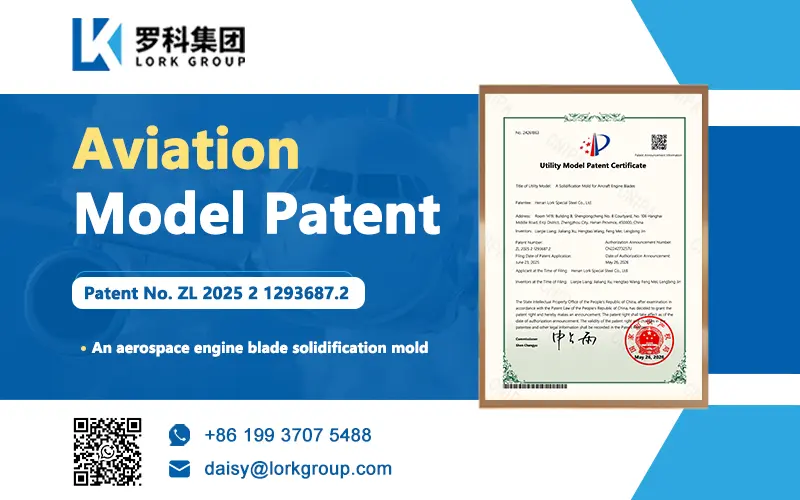
Patent No. ZL 2025 2 1293687.2 focuses on the precision casting of aero-engine blades, demonstrating the Group's sustained innovation capabilities in the fields of specialty steels and precision forming technologies.
Lork Group Granted National Utility Model Patent for an Aviation Engine Blade Solidification Mold