
Characteristics of Nickel Alloys
2024-09-06

What makes a nickel alloy?
Obviously, the common ingredient in all nickel alloys is … nickel. This durable metal brings to the mix exceptional corrosion, oxidation and temperature resistance combined with a high degree of ductility and formability. It’s no wonder that nickel alloys are a stalwart choice across a range of industries and sectors. In fact, it’s estimated that year to year, 90% of all nickel sold is purchased especially to make alloys.
Nickel alloys can be made in a variety of different compositions, each providing its own unique benefits. They make materials lighter, longer lasting, corrosion resistant, and strong enough for the toughest applications.
Nickel and nickel alloys are non-ferrous metals with high strength and toughness, excellent corrosion resistance, and superior elevated temperature properties. Products differ in terms of composition, grade, shape, dimensions, and features. Commercially pure, unalloyed, or very low alloy nickel does not contain or contains only very small amounts of alloying elements. By contrast, nickel alloys contain significant amounts of added elements or constituents. Clad or bimetal stock consists of two different alloys that are bonded integrally together. Metal matrix composites have a composite or reinforced metal or alloy matrix filled with a second component, which may be in particulate, chopped fiber, continuous filament, or fabric form. Other unlisted, specialty or proprietary nickel and nickel alloys are also available. These materials are often based on a unique alloy system, use a novel processing technology, or have properties tailored for specific applications.
Many nickel and nickel alloys meet the compositional standards of the Unified Numbering System (UNS), a specification established by the American Society for Testing and Materials (ASTM), the Society of Automotive Engineers (SAE), and metal trade associations such as the American Iron and Steel Institute (AISI). The UNS assigns metals and alloys a lettered prefix and a five-digit number. Nickel and nickel alloys belong to the UNS N category and have designations such as UNS N02200. Other standards for nickel and nickel alloys include casting grades, European Norm (EN), American Society of Mechanical Engineers (ASME) standards, and U.S. military specifications (MIL-SPEC). QQ and QQS prefixes are used to designate specific MIL-SPEC metals.
Selecting nickel and nickel alloys requires an analysis of dimensions, production processes, and performance features. Outer diameter (OD), inner diameter (ID), overall length, and overall thickness are important dimensions. Most materials are cast, wrought, extruded, forged, cold-finished, hot-rolled, or formed by compacting powdered metals or alloys. Performance features for nickel and nickel alloys include resistance to corrosion, heat, and wear.
Nickel is well-known as an essential alloying element in stainless steels, Ni-Cu alloys, Ni-Fe alloys, Ni-Cr-Fe alloys, super alloys, as nickel-chromium alloys and special corrosion-resistant and high temperature alloys. Nickel ferromagnetic with a density of 8.9 g/cm3. It is ductile and malleable like steel. Nickel alloys are well-known for their high temperature strength and good resistance to corrosion.
Classification of Nickel Alloys
The nickel alloys can be classified in the following groups on the basis of their chemical compositions:
(1)Nickel
- Pure nickel (99.56%)
- Commercially pure nickel (wrought) 99.6–99.7%.
(2)Nickel and copper
- Low nickel alloys (2–13% Ni)
- Cupronickel (10–30% Ni)
- Non-magnetic alloys (~60% Ni)
- High nickel alloys (over 50% Ni)
(3)Nickel and iron
- Wrought alloys steels (0.5–9% Ni)
- Cast alloy steels (0.5–0.9% Ni)
- Alloy cast iron (1–6, 14–36% Ni)
(4)Iron-nickel and chromium alloys
- Stainless steels (2–25% Ni)
- Maraging steels (18% Ni)
(5)Nickel-chromium-molybdenum and iron-nickel base precipitation hardened alloys.
Characteristics of Nickel Alloys
(1) Nickel-Copper Alloys
These alloys are well-known for their excellent corrosion resistance to seawater. They have been used as propellers, pump shafts, impellers and condenser tube materials. The best known is Monel (Alloy 400). It is resistant to brine and immune to stress corrosion cracking and pitting in chloride and caustic alkaline solutions. It is also resistant to HF and fluorine containing media.
Monel alloy R-405 has specified amounts of sulfur for improved machining characteristics. Monel K 500 has the dual advantage of improved mechanical strength and excellent corrosion resistance. It can retain strength up to 650°C and ductility up to 134°C.
(2) Nickel-Chrome-Iron Alloys
These alloys contain a high percentage of nickel and excellent capability to withstand high temperature oxidizing environment. Alloys, such as Inconel 600, 690, 718 and X750, belong to this category. Alloy Inconel 600 (Ni 76, Cr 15.5, Fe 8) is the basic alloy in this class with excellent corrosion resistance at elevated temperatures (~1092°C). It can, however, be subjected to pitting or crevice corrosion. Other alloys in this family include alloy 690 (29% Cr) which shows excellent resistance to SCC in chloride media and low corrosion rates at high temperatures. It is used in furnaces for petrochemical processing and in coal gasification units.
Alloy Inconel X750 contains additions of aluminum, niobium and titanium which form an intermetallic compound, Ni3(Al, Ti) to make it age hardenable and provide high strength. It is extremely resistant to SCC in chloride environment. It is used in gas turbines, vacuum envelopes, extrusion dies and springs.
(3) Nickel-Iron-Chromium Alloys
These alloys represent another version of Ni-Cr-Fe alloys and contain 30–44 % of nickel. Alloy 800 of this series has been extensively used in heat exchangers in the petrochemical industry, because of its excellent resistance to stress corrosion cracking in chloride environments and cracking in polythionic acid. It offers an excellent resistance to creep and rupture. They are used for high environments where resistance to oxidation and corrosion is required. Incoloy 825 has proved highly successful in applications in H2SO4, HCl, phosphoric acid and clean and polluted seawater.
(4) Nickel-Chromium-Molybdenum Alloys
This family of alloys are mainly used in the chemical processing industry and contain 45–60% Ni. Hastelloy has been successfully used in high temperature applications (up to 1204°C). The Hastelloy C series have served the chemical industry for a long time. The modified version of Hastelloy C is Hastelloy C-276 in which silicon and C content are substantially reduced (0.005% C, 0.04% Si). It is used successfully in the petrochemical industry. Alloys 625 and 617are high temperature strength alloys and exhibit a high resistance to corrosion. Alloy 625 is used extensively in seawater applications. It is highly resistant to pitting and stress corrosion cracking. Other alloys, like Udimet 500, 520, 600 and 700 retain high temperature strength up to 982°C.
Selecting a suitable material is often a very tedious process. Lork Group offers a wide range of materials which different mechanical properties to suit all kinds of metal projects. Do you want to know more? Just get in touch with a member of our sales team to ask any questions or to have a chat about your needs.
Marine engineering Hastelloy C22 Chlorination system
High-Performance Inconel Nickel Alloy —— Selection of Materials for Corrosive Environment
Related Article
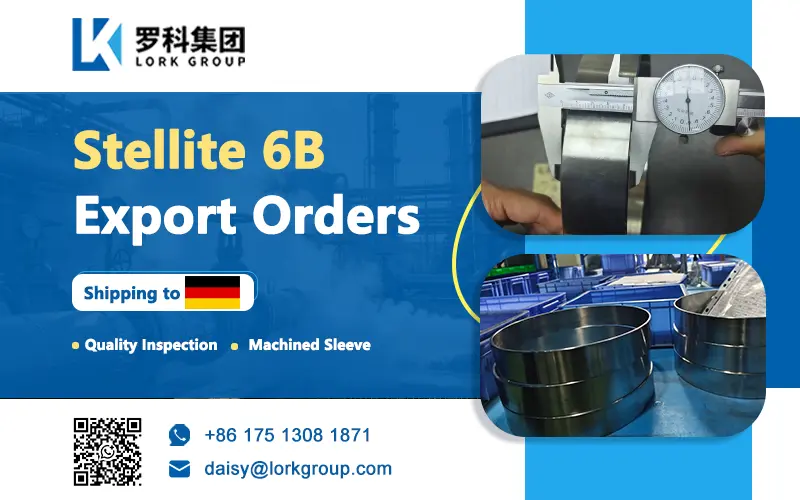
The Lork Group possesses extensive experience in processing cobalt-based alloys and maintains a comprehensive quality control system. The Stellite 6B bushings exported in this shipment—measuring 9 cm in width and 36 cm in diameter—are high-precision components. Delivery takes place only after the products have passed inspection; this process reflects our unwavering commitment to quality and is key to earning the trust of our German clients.
Lork Group Stellite 6B machined bushings exported to Germany

As an international group with 15 years of experience in specialty alloy supply chain management, Lork Group offers product selection consultation and supply services for the full range of Elgiloy, Pyromet, Elinvar, and Ni-Span-C 902 alloys. Please feel free to contact Lork Group’s sales and technical teams for the latest price quotes, material technical data sheets, or supplier coordination support.
Supplier of Elgiloy Pyromet Elinvar and Ni-Span-C 902 high-elasticity alloys
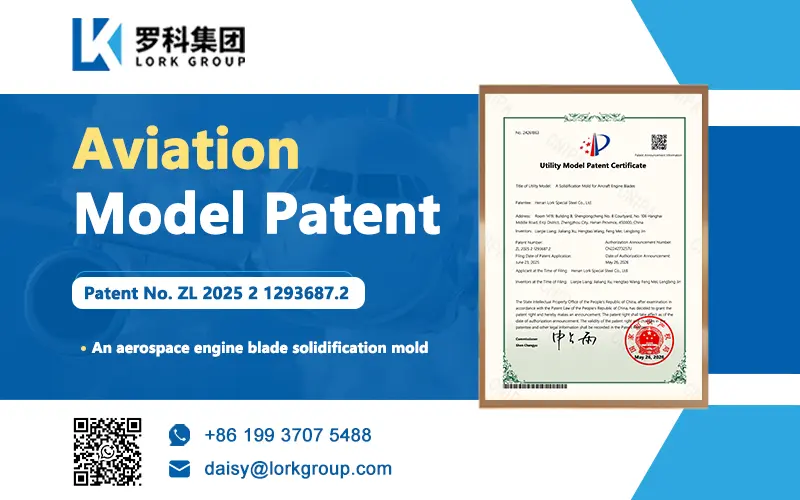
Patent No. ZL 2025 2 1293687.2 focuses on the precision casting of aero-engine blades, demonstrating the Group's sustained innovation capabilities in the fields of specialty steels and precision forming technologies.
Lork Group Granted National Utility Model Patent for an Aviation Engine Blade Solidification Mold
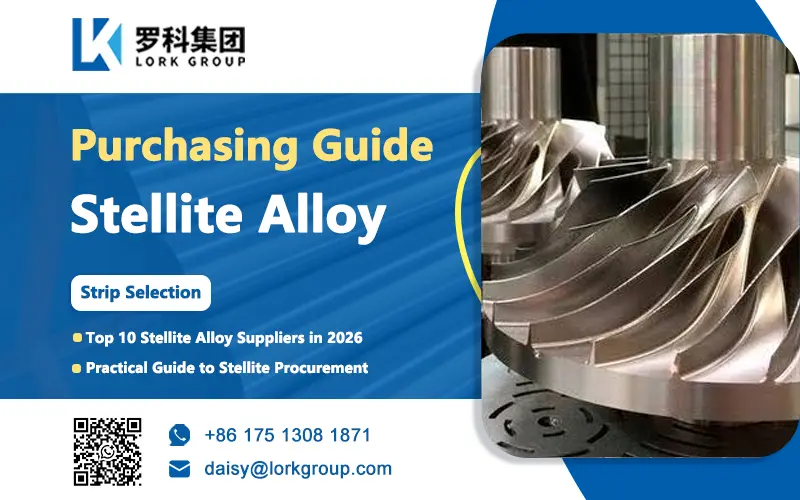
If you are unsure whether to use Stellite 6, 12, or 21 for your current project, simply send us a description of the operating conditions, and Lork Group engineers will provide a free "grade recommendation." Click the button below to submit details regarding operating temperature, corrosive media, and impact conditions, and we will respond within 24 hours.
Top 10 Suppliers of Stellite Alloy Materials for 2026