
Guide to Using Inconel Alloy 600
2024-07-30

Inconel alloy 600 is designated as UNS N06600 and Werkstoff Number 2.4816. Is a standard engineering material that has great resistance to heat and corrosion.
Inconel 600 features superior strength and can be easily formed. It can also be hardened and strengthened through cold work. Inconel alloy 600 is non-magnetic and is resistant to a wide range of corrosive materials.
Standard product forms are pipe, sheet, strip, plate, round bar, flat bar, forging stock, hexagon, wire and extruded section.
Lork Group stocks Nickel alloy in a range of sizes. Nickel alloy Material can be supplied in random lengths, cut to order or machined to customer's specifications. We provide tailored solutions that meet specific material specifications, To buy or learn more about Inconel alloy contact us now, we will be in touch shortly.
Inconel alloy 600 Characteristic
1.Good corrosion resistance property for the reduction, oxidation, Nitric and other media.
2.Good stress corrosion cracking resistance property in both room temperature and high temperature.
3.Good corrosion resistance of the dry chlorine and chlorine hydride.
4.Good mechanical property when below zero, room temperature and high temperature.
5.Good anti-creep rupture strength, with the recommendation of 700℃ or above working environment.
Inconel alloy 600 High-Temperature Applications
Inconel alloy 600 is widely used in the furnace and heattreating fields for retorts, boxes, muffles, wire belts, roller hearths, and similar parts which require resistance to oxidation and to furnace atmospheres. The alloy is the standard material for nitriding containers because of its resistance to nitrogen at high temperatures.
Inconel alloy 600 resists attack by sulfur compounds at moderate temperatures, but it is subject to sulfidation in high-temperature, sulfur-containing environments. Molybdenum disulfide, a lubricant sometimes used to aid parts assembly, should not be used if the material will be subsequently exposed to temperatures above 800°F (427°C).
Working Instructions
Inconel alloy 600 is readily fabricated by either hot or cold working and can be joined by standard welding, brazing, and soldering processes. Although the alloy can be hardened and strengthened only by cold work, a wide range of mechanical properties can be obtained in finished parts by combining cold work and thermal treatments.
Heat Treatment
The behavior of the alloy during heating is governed by a number of interacting variables: amount of cold work, grain size, chemical composition, and dimensions of the material. Consequently, times and temperatures for heat treatment are usually experimentally determined.
Heating and Pickling
Inconel alloy 600, like all nickel-base alloys, must be clean before it is heated and must be heated in a sulfur-free atmosphere. Furnace atmosphere for forging or open annealing should be slightly reducing to prevent excessive oxidation.
The rate of cooling after heating has little effect on the mechanical properties of Inconel alloy 600. However, the alloy is subject to carbide precipitation in the 1000° to 1400°F (540 to 760°C) temperature range and should be rapidly cooled through that range if the material is to be pickled or used in an environment requiring freedom from sensitization. The alloy can be bright-heated only in very dry hydrogen or in a vacuum and usually must be pickled if a bright surface is required.
Hot and Cold Forming
The normal hot-working temperature range for Inconel alloy 600 is 1600° to 2250°F (870° to 1230°C). Heavy hot work should be done between 1900° and 2250°F (1040° and 1230°C); light work can be continued down to 1600°F (870°C). The alloy has low ductility at temperatures between 1200° and 1600°F (650° and 870°C) and should not be worked in that range.
High tensile properties can be developed in the material by careful working at temperatures below 1200°F (650°C).
Inconel alloy 600 is cold-formed by the standard processes used for steel and stainless steel.
Machining
Inconel alloy 600 is slightly more machinable than Type 304 stainless steel and slightly less machinable than Type 303 free-machining stainless steel.
The alloy is best handled on heavy-duty equipment using cutting tools large and heavy enough to withstand the loads and to quickly dissipate the heat generated. Tools must be sharp and have the proper geometry.
Inconel alloy 600 is readily joined by conventional welding processes. Welding materials for joining alloy 600 are INCONEL Welding Electrode 182 for shielded metal-arc welding*, INCONEL Filler Metal 82 for gas tungsten-arc and gas metal-arc welding, and INCONEL Filler Metal 82 and INCOFLUX 4 Submerged Arc Flux for the submerged-arc process.
Welds made with INCONEL Welding Electrode 182 may have decreased ductility after extended exposure to temperatures of 1000° to 1400°F (540° to 760°).
Advantages and objectives of stainless steel bright annealing
Advantages of using nickel alloys in chemical processing industry
Related Article
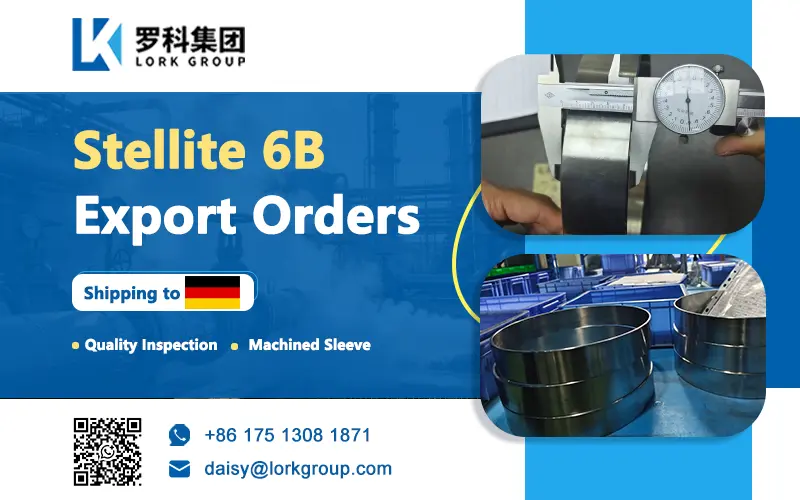
The Lork Group possesses extensive experience in processing cobalt-based alloys and maintains a comprehensive quality control system. The Stellite 6B bushings exported in this shipment—measuring 9 cm in width and 36 cm in diameter—are high-precision components. Delivery takes place only after the products have passed inspection; this process reflects our unwavering commitment to quality and is key to earning the trust of our German clients.
Lork Group Stellite 6B machined bushings exported to Germany

As an international group with 15 years of experience in specialty alloy supply chain management, Lork Group offers product selection consultation and supply services for the full range of Elgiloy, Pyromet, Elinvar, and Ni-Span-C 902 alloys. Please feel free to contact Lork Group’s sales and technical teams for the latest price quotes, material technical data sheets, or supplier coordination support.
Supplier of Elgiloy Pyromet Elinvar and Ni-Span-C 902 high-elasticity alloys
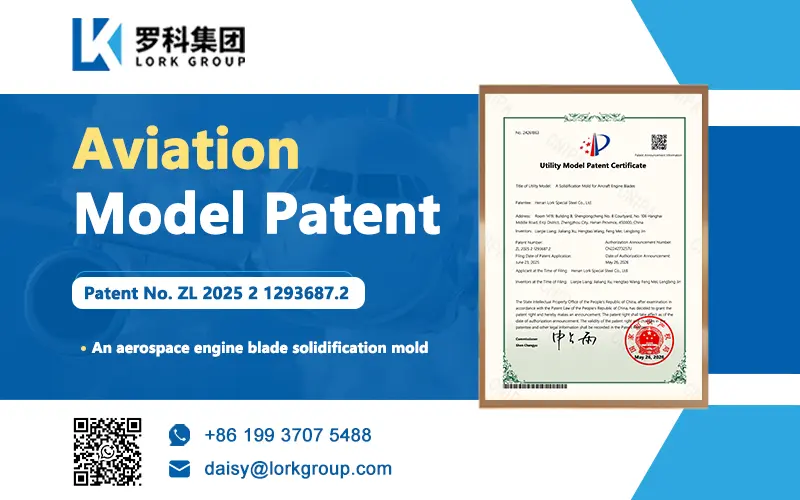
Patent No. ZL 2025 2 1293687.2 focuses on the precision casting of aero-engine blades, demonstrating the Group's sustained innovation capabilities in the fields of specialty steels and precision forming technologies.
Lork Group Granted National Utility Model Patent for an Aviation Engine Blade Solidification Mold
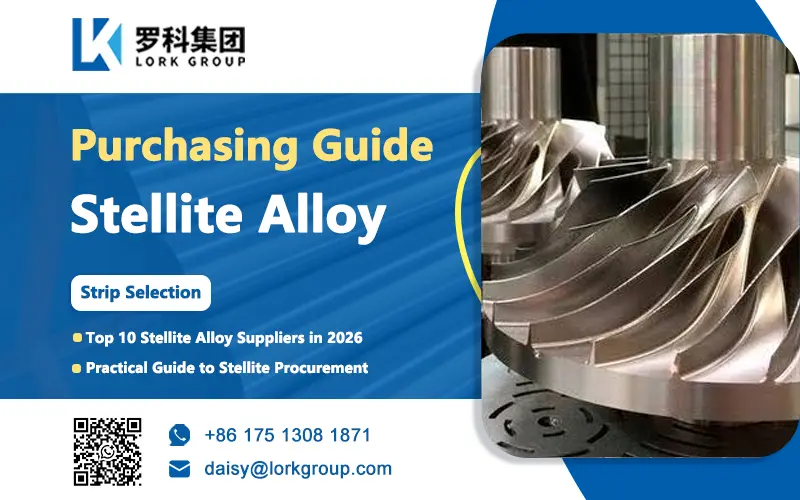
If you are unsure whether to use Stellite 6, 12, or 21 for your current project, simply send us a description of the operating conditions, and Lork Group engineers will provide a free "grade recommendation." Click the button below to submit details regarding operating temperature, corrosive media, and impact conditions, and we will respond within 24 hours.
Top 10 Suppliers of Stellite Alloy Materials for 2026