Lork Group Granted National Utility Model Patent for an Aviation Engine Blade Solidification Mold
2026-07-28
Overview
(Zhengzhou, July 28, 2026) Recently, Henan Lork Special Steel Co., Ltd., a subsidiary of Lork Group, received a utility model patent certificate from the China National Intellectual Property Administration. The patent is titled "A Solidification Mold for Aero-engine Blades" (Patent No. ZL 2025 2 1293687.2), with an authorization announcement date of May 26, 2026. Securing this patent further enriches the Group's technical capabilities in the manufacturing of critical aero-engine components.
Overview of Patented Technology
This utility model patent relates to the field of aero-engine blade casting technology, specifically providing a mold structure design tailored to the blade solidification and forming process. As core hot-section components of the propulsion system, the casting quality of aero-engine blades directly impacts engine performance and operational safety. During precision casting, the design of the solidification mold plays a decisive role in determining the density of the blade's microstructure, dimensional accuracy, and the control of internal defects.
The patented technical solution focuses on optimizing the structure of the solidification mold. It aims to address issues found in existing technologies—such as uneven temperature field distribution and inadequate feeding efficiency during the blade solidification process—thereby enhancing process stability and the final product yield through rational mold structure design.
Technical Background and Industry Value
Aero-engine blades are typically manufactured using the investment casting process. This solidification process involves multiple stages—such as mold filling with molten alloy, directional solidification, and feeding—making process control highly challenging. Currently, the domestic aero-engine blade manufacturing sector faces technical hurdles, including fluctuating yield rates for blades with complex geometries and difficulties in controlling grain size. As the core tooling for the casting process, the design quality of the mold directly impacts both the quality of the blades and their manufacturing costs.
Research by institutions such as Northwestern Polytechnical University indicates that the design and manufacture of precision casting molds for turbine blades represent a critical technical challenge in aero-engine development; improvements in mold design capabilities can boost design efficiency by 60% and NC programming efficiency by 50%. The patent recently secured by the Lork Group stands as a tangible result of its sustained investment in this technical field.

This is a translation. For more information regarding Lork Group's certifications, please visit the "About Us" section.
Or contact us to obtain the original copy.
Lork Group's Technology Strategy
Securing this patent marks another significant milestone for the Lork Group in the fields of specialty aviation steel and precision casting technology, following its previous attainment of multiple international certifications—including ISO 9001, ISO 28000, ISO 45001, ISO 24001, AS9100, and CE—as well as five software copyrights and various other patents.
While the AS9100D aerospace quality management system certification has already provided a robust framework for serving aviation clients, the implementation of this new patent further solidifies the Group's technical foundation in aero-engine blade manufacturing, establishing a closed-loop intellectual property system that spans material R&D, process design, and tooling.
Future Outlook
Mr. Jin, a representative from the Lork Group’s technology center, stated that the Group will continue to focus on tackling key technical challenges in high-end application sectors—such as aero-engines, biomedical implants, and semiconductor manufacturing. Centered on the material preparation and precision forming of specialty steels and high-temperature alloys, the Group aims to build a highly competitive patent portfolio and establish robust technological barriers. Moving forward, the Group will continue to leverage its foundational digital ecosystem—comprising "standards hubs," "digital platforms," and "scenario-based think tanks"—to provide customers with systematic solutions spanning everything from materials to manufacturing processes.
Top 10 Suppliers of Stellite Alloy Materials for 2026
Related Article
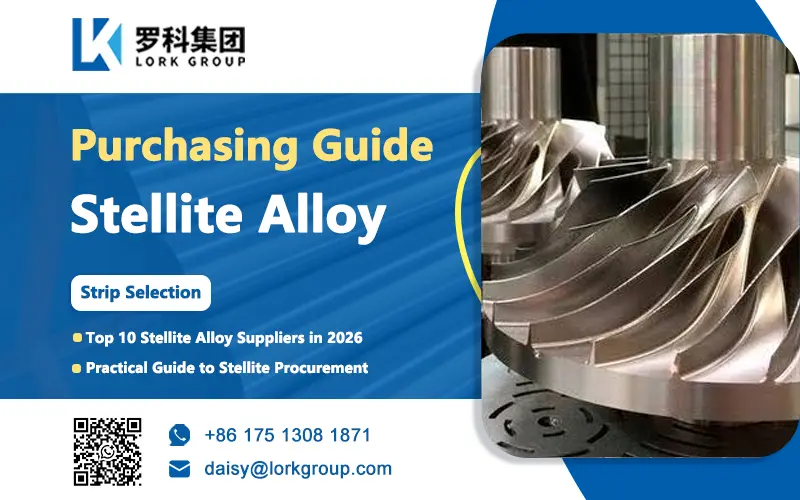
If you are unsure whether to use Stellite 6, 12, or 21 for your current project, simply send us a description of the operating conditions, and Lork Group engineers will provide a free "grade recommendation." Click the button below to submit details regarding operating temperature, corrosive media, and impact conditions, and we will respond within 24 hours.
Top 10 Suppliers of Stellite Alloy Materials for 2026
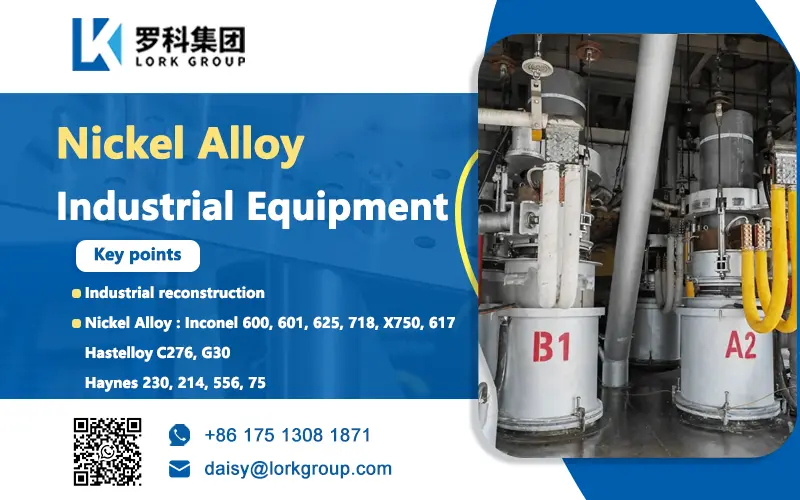
To meet the demand for metallurgical equipment and industrial furnaces in post-war industrial reconstruction, Lork Group supplies nickel alloy components—including high-temperature furnace tubes (for sulfur-containing atmospheres), radiant tubes (for carburizing environments), combustion chamber liners, fasteners, and springs.
Nickel Alloys for Core Applications in Metallurgical Equipment and Industrial Furnaces