
The most common alloy material used for surgical instruments
2024-09-12

There are many different considerations when choosing a material to use in the medical industry. After all, the wrong material choice could lead to disastrous consequences. In this article, we take a look at which metals alloys are used for surgical instruments, and why.
The most common alloy material used for surgical instruments are:Stainless steel, Titanium,Tantalum,Platinium,Palladium. Stainless steel is one of the most commonly used alloy material in the manufacture of surgical implements.
Here’s a quick look at how some of these can benefit you: read on to learn why these metals were chosen.
The metals used for surgical instruments have to adhere to strict criteria.
Firstly, the alloy must be relatively malleable so it can be shaped without causing flaws, but not too malleable as it needs to hold its shape once manufactured. Depending on the instrument, the alloy material used may also need to be fairly ductile, as many surgical instruments are long and thin, e.g. scalpels, forceps, scissors, etc.
The surface of the alloy material needs to be tough and needs to have a satin finish, so the instruments are easy to clean and won’t harbour bacteria, helping to prevent the spread of infection. Finally, the metal needs to be inert with the human body, so it won’t cause any metal contamination when used internally.
When it comes to biomedical instruments, not all metals are up to the job, especially base metals. In fact, most surgical instruments are made from metal alloys. Stainless steel has traditionally been the metal alloy of choice, but there are alternatives when necessary.
Stainless steel grades for surgical instruments
Stainless steel (sometimes referred to as inox steel) is one of the most commonly used alloy material in the manufacture of surgical implements.
Austenitic 316 (AISI 316L) steel is a type of stainless steel used often, and is referred to as “surgical steel”. This is because it is a tough metal that is very resistant to corrosion. It is also used frequently in the chemical industry.
AISI 301 is the most commonly used metal for manufacturing springs which are useful in medical instruments. It gains mechanical strength when cold-worked, but loses corrosion resistance.
Stainless steel can withstand temperatures as high as 400°C, meaning it can be sterilised easily in an autoclave at 180°C. It also has the benefit of being almost as tough and hard-wearing as carbon steel.
Titanium in surgical tools
Titanium alloy has only recently started being used as a material for surgical instruments, taking off in the 1960s.
The most obvious benefit of titanium is its superior strength. Its tensile strength is almost the same as carbon steel and it is 100% corrosion resistant. Despite its overall strength, it is more flexible than stainless steel and is approximately 40% lighter.
Titanium is perfect for both surgical instruments and implants, as it is biocompatible and has the intrinsic quality that it fuses well with human bones. For this reason, it has become the metal of choice for orthopaedic rods, pins, plates, and dental implants.
Titanium is more resistant to heat than stainless steel, withstanding up to 430°C, and it expands and contracts less when heated and cooled.
Depending on the properties required for the instrument, Titanium Grade 1 or 2 can be machined, welded, and hot or cold-worked quite easily, so it is a versatile metal too.
Overall, titanium is a tough, durable metal that has become a common material used for all kinds of medical purposes.
Tantalum in orthopaedics
Tantalum, a refractory metal, is strong, ductile and has a very high melting point (3017°C). But for the medical industry, its most attractive benefit is its high biocompatibility.
The metal is immune to bodily fluids, and also highly corrosion resistant, so it can be used in surgery without causing adverse effects. For the same reasons, it’s also used for implants and bone replacement material in prostheses. Its ductility is also an attractive property, as it can be drawn into thin wire, while its malleability allows it to be easily fabricated into various shapes.
Platinum and palladium in medicine
Although platinum and palladium are expensive precious metals, they have similar properties that make them uniquely suited to certain surgical applications.
Firstly, they can both be easily formed into a variety shapes as they are highly malleable and ductile, meaning you can easily make rolls, sheets, tubes, wires, etc. They are especially useful for intricate parts, ideal for precision surgical instruments.
Both platinum and palladium are highly corrosion resistant and inert, so they won’t cause problems when in contact with the body or internal organs.
One of the major uses in recent years has been creating ultra-thin wires that surgeons use to guide and position implants such as catheters and stents.
Another advantage is that both platinum and palladium show up very clearly on X-ray making them ideal to be used as markers on implants.
They are both strong, durable metals. The only real differences between the two are density, mass, melting points, and price, with palladium being the cheaper of the two.
Surgical instrument metals
Hopefully, this article has given you some idea of the different types of metal used to make surgical instruments and their properties.
As you have seen, the different varieties of stainless steel are the most popular as they are relatively cheap, plentiful, and practical for most applications.
Titanium is the next most common, as it has additional strength and is ideal for orthopaedic implants due to the fact it fuses easily with bone.
Tantalum’s properties make it an ideal choice to use in surgical instruments.
Finally, there are the precious metals, platinum, and palladium. These are the most expensive, which is why they are rarely used in a medical setting, but they are ideal for small, precision implements and parts.
Lork Group are a supply chain management company for Stainless Steel, high temperature alloys, rare metal alloys, and rare-earth alloys.
From cutting-edge research and development to refined forgings, to secondary quenching and tempering, and precision deep processing, the integrated management system of the entire process ensures that we provide customers with a full range of solutions.
Contact Lork Group for metal material Solutions
The experts at Lork Group are ready to help you choose the most suitable type of metal for your .
We have built a reputation as a trusted partner for quality materials, distributing numerous grades of stainless steel, super alloy and hard-to-find metals. Our raw metal bars, rings, plates, pipes, and tubing are available from stock.
To learn more about the Lork Group metal difference and our material offerings stainless steel and super alloy, contact us or request a quote today.
Application of titanium alloy in biomedical field
Select high-temperature alloys based on their composition, characteristics, and applications
Related Article
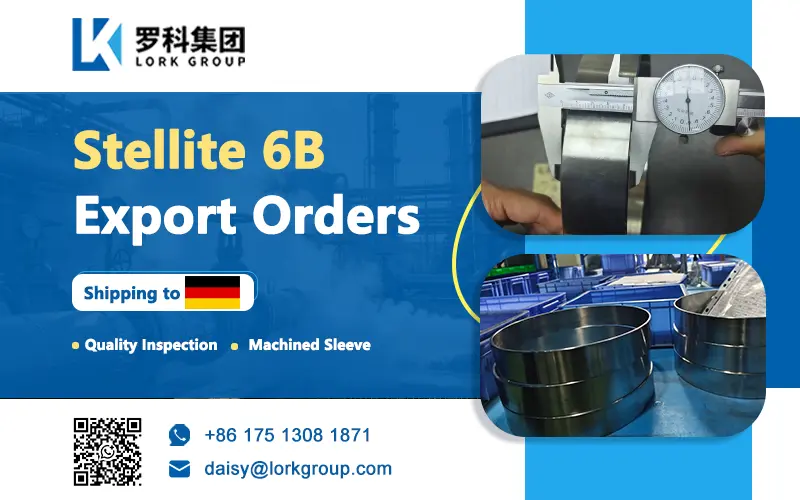
The Lork Group possesses extensive experience in processing cobalt-based alloys and maintains a comprehensive quality control system. The Stellite 6B bushings exported in this shipment—measuring 9 cm in width and 36 cm in diameter—are high-precision components. Delivery takes place only after the products have passed inspection; this process reflects our unwavering commitment to quality and is key to earning the trust of our German clients.
Lork Group Stellite 6B machined bushings exported to Germany

As an international group with 15 years of experience in specialty alloy supply chain management, Lork Group offers product selection consultation and supply services for the full range of Elgiloy, Pyromet, Elinvar, and Ni-Span-C 902 alloys. Please feel free to contact Lork Group’s sales and technical teams for the latest price quotes, material technical data sheets, or supplier coordination support.
Supplier of Elgiloy Pyromet Elinvar and Ni-Span-C 902 high-elasticity alloys
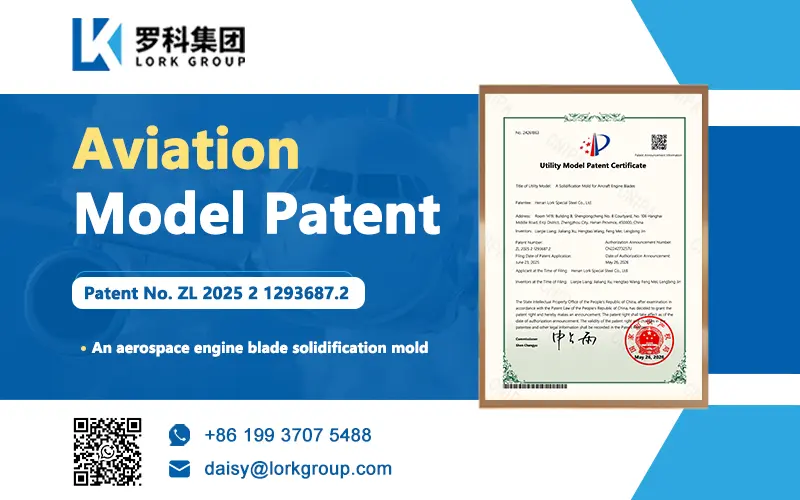
Patent No. ZL 2025 2 1293687.2 focuses on the precision casting of aero-engine blades, demonstrating the Group's sustained innovation capabilities in the fields of specialty steels and precision forming technologies.
Lork Group Granted National Utility Model Patent for an Aviation Engine Blade Solidification Mold

If you are unsure whether to use Stellite 6, 12, or 21 for your current project, simply send us a description of the operating conditions, and Lork Group engineers will provide a free "grade recommendation." Click the button below to submit details regarding operating temperature, corrosive media, and impact conditions, and we will respond within 24 hours.
Top 10 Suppliers of Stellite Alloy Materials for 2026