
What is the difference between Incoloy 825 and 925?
2025-08-26
Incoloy 825 and Incoloy 925 are nickel-iron alloys designed for corrosive environments, but they serve distinctly different primary purposes.
The fundamental difference lies in their strength level and how it is achieved:
- Incoloy 825 is a solid-solution strengthened alloy. It is used in its annealed state and is prized for its exceptional corrosion resistance.
- Incoloy 925 is a precipitation-hardened alloy. It is a derivative of 825 that has been chemically modified to be age-hardened, resulting in very high strength while retaining good corrosion resistance.
Here is a detailed breakdown of their differences:
At a Glance: Incoloy 825 vs. 925
| Feature | Incoloy 825 (UNS N08825) | Incoloy 925 (UNS N09925) |
|---|---|---|
| Primary Purpose | Corrosion Resistance | High Strength + Corrosion Resistance |
| Strengthening Method | Solid-Solution (Annealed) | Precipitation Hardening (Aged) |
| Key Alloying Elements | Ni, Cr, Mo, Cu, Ti | Ni, Cr, Mo, Cu, Ti, Al |
| Key Characteristic | Excellent ductility and fabricability | High yield and tensile strength |
| Typical Yield Strength | ~250 MPa (36 ksi) (Annealed) | ~550 MPa (80 ksi) (Aged) |
| Corrosion Resistance | Superior in a wide range of media | Very Good, but slightly less than 825 |
| NACE MR0175/ISO 15156 | Approved for sour service | Approved for sour service |
Detailed Comparison
1. Chemistry and Metallurgy
- Incoloy 825: Its composition is optimized for corrosion resistance. It contains Nickel (for chloride stress corrosion cracking resistance), Chromium (for oxidizing environments), Molybdenum (for reducing environments and pitting resistance), and Copper (for sulfuric acid resistance). Titanium (Ti) is added to stabilize the alloy against sensitization during welding.
- Incoloy 925: It has a very similar base composition to 825 but includes key additions of Aluminum (Al) and a higher Titanium (Ti) content. These elements allow it to form the gamma prime (ϒ') phase during a specific heat treatment (aging), which precipitates throughout the microstructure, dramatically increasing its strength.
2. Mechanical Properties (The Biggest Difference)
This is the most critical differentiator for engineers selecting a material.
- Incoloy 825 has good, ductile mechanical properties similar to other austenitic alloys. It is not a high-strength alloy.
- Incoloy 925, after the aging process, achieves approximately double the yield strength and tensile strength of 825. This makes it capable of handling much higher mechanical loads and pressures.
3. Corrosion Resistance
- Incoloy 825 is considered the benchmark for corrosion resistance in this family. It excels in sulfuric and phosphoric acids, seawater, and chloride-containing environments. It is highly resistant to pitting, crevice corrosion, and stress corrosion cracking.
- Incoloy 925 offers very good corrosion resistance, very similar to 825, and is fully approved for sour service (NACE MR0175). However, due to its different microstructure from aging, its general corrosion resistance in some very aggressive media can be marginally lower than 825. It is still far superior to stainless steels.
Application Examples
Incoloy 825 is typically used for:
- Chemical processing equipment (pickling tanks, heating coils, reactor vessels)
- Pollution control and acid production equipment
- Seawater cooling tubes and heat exchangers
- Components handling sulfuric acid and other corrosive chemicals.
Incoloy 925 is typically used for:
- Downhole oil & gas equipment in sour (H₂S) wells: tubing hangers, valves, mandrels, perforated guns, connectors.
- Fasteners and high-strength bolts for offshore platforms and chemical reactors.
- Shafts and agitators that require both high strength and corrosion resistance.
- Any component where the mechanical load is too high for 825.
Choose Incoloy 825 when your primary requirement is maximum corrosion resistance in a severe chemical environment and the mechanical loads are within the standard range for nickel alloys.
Choose Incoloy 925 when you need high mechanical strength (e.g., for high-pressure wells or load-bearing components) in addition to good corrosion resistance, particularly in sour oil and gas service.
Lork Group supplies both Incoloy 825 and 925 in various forms. We can provide the technical support to help you select the right alloy for your specific application, environment, and mechanical requirements. Contact us for a consultation.
Buyer's Guide to 8 Precision Alloys - Lork Group
Monel 400 Pipe: Robust Nickel-Copper Alloy for Demanding Applications
Related Article
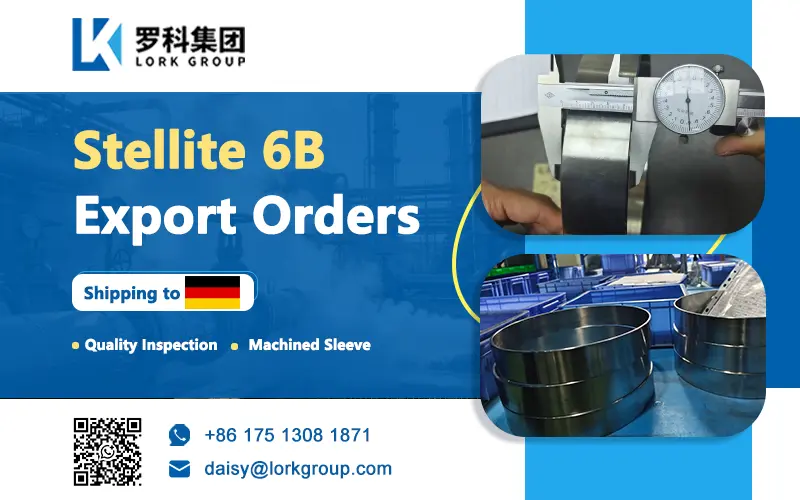
The Lork Group possesses extensive experience in processing cobalt-based alloys and maintains a comprehensive quality control system. The Stellite 6B bushings exported in this shipment—measuring 9 cm in width and 36 cm in diameter—are high-precision components. Delivery takes place only after the products have passed inspection; this process reflects our unwavering commitment to quality and is key to earning the trust of our German clients.
Lork Group Stellite 6B machined bushings exported to Germany

As an international group with 15 years of experience in specialty alloy supply chain management, Lork Group offers product selection consultation and supply services for the full range of Elgiloy, Pyromet, Elinvar, and Ni-Span-C 902 alloys. Please feel free to contact Lork Group’s sales and technical teams for the latest price quotes, material technical data sheets, or supplier coordination support.
Supplier of Elgiloy Pyromet Elinvar and Ni-Span-C 902 high-elasticity alloys
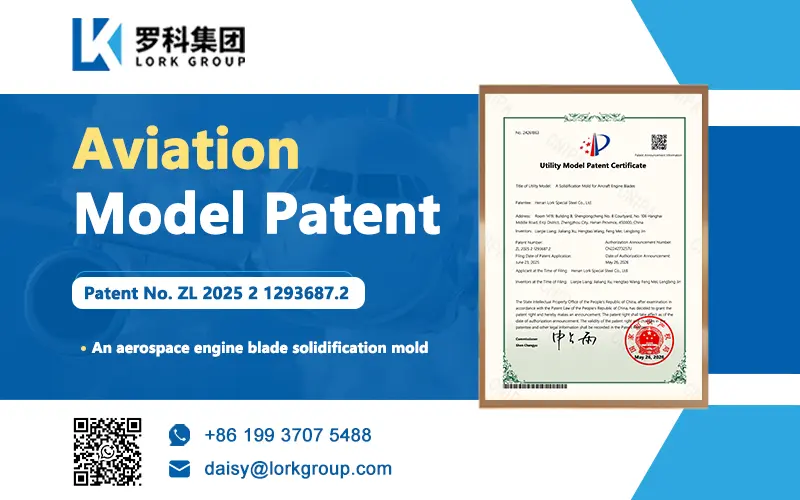
Patent No. ZL 2025 2 1293687.2 focuses on the precision casting of aero-engine blades, demonstrating the Group's sustained innovation capabilities in the fields of specialty steels and precision forming technologies.
Lork Group Granted National Utility Model Patent for an Aviation Engine Blade Solidification Mold
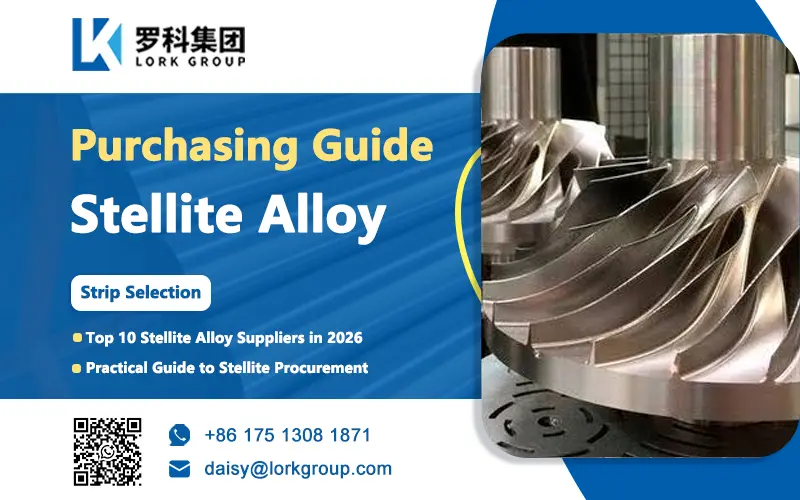
If you are unsure whether to use Stellite 6, 12, or 21 for your current project, simply send us a description of the operating conditions, and Lork Group engineers will provide a free "grade recommendation." Click the button below to submit details regarding operating temperature, corrosive media, and impact conditions, and we will respond within 24 hours.
Top 10 Suppliers of Stellite Alloy Materials for 2026